Free MCAT study note
Anomers vs Epimers: Carbohydrate Stereoisomers for the MCAT
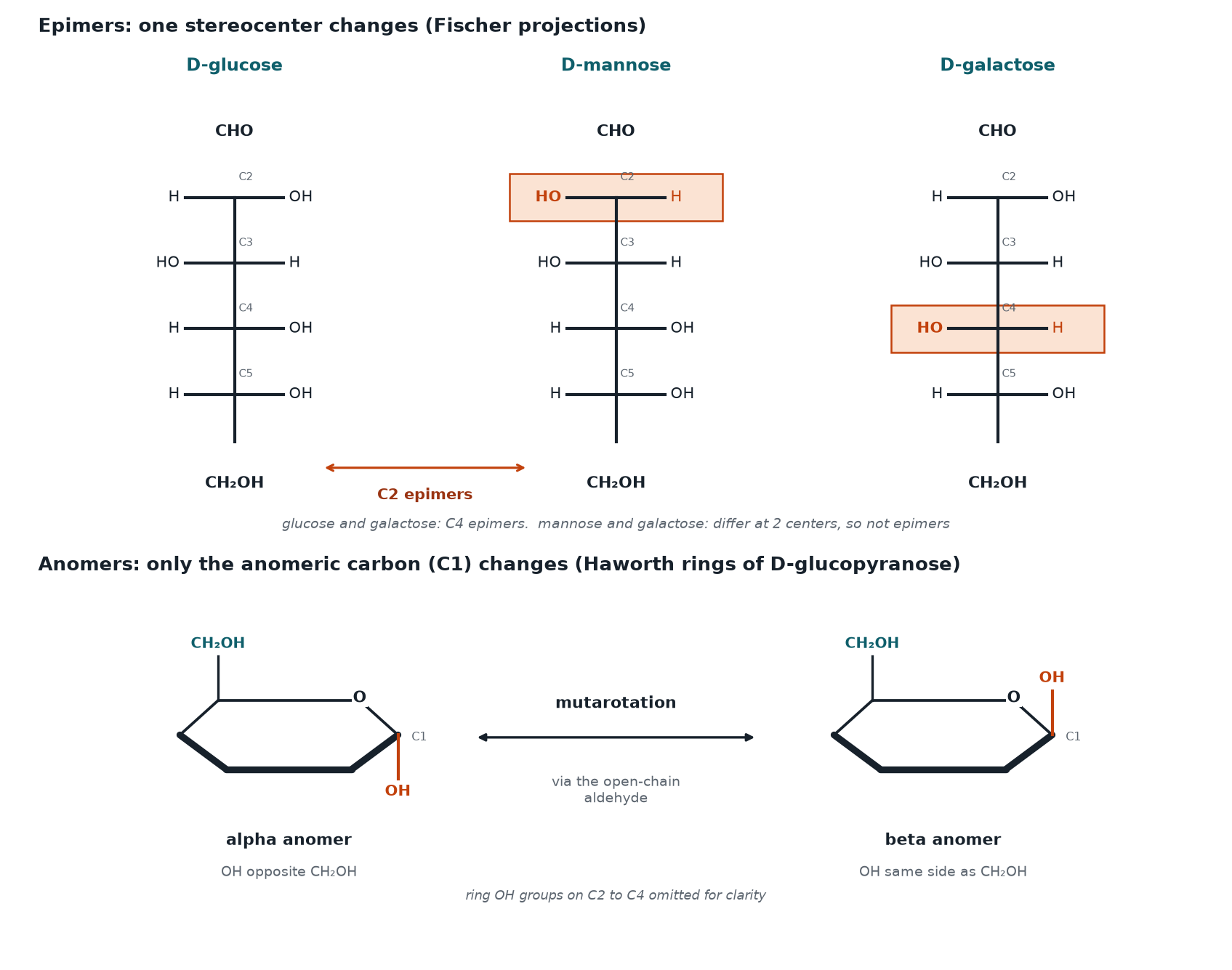
Epimers are sugars that differ in configuration at exactly one stereocenter, any one. Anomers are a special kind of epimer that differ only at the anomeric carbon, the new stereocenter created when a sugar closes into a ring (C1 for aldoses such as glucose, C2 for ketoses such as fructose). So every pair of anomers is a pair of epimers, but most epimers are not anomers. D-glucose and D-galactose are epimers at C4; alpha-D-glucose and beta-D-glucose are anomers.
The family tree of sugar isomers
Sugar isomer questions get easier if you sort the vocabulary into a tree before you memorize examples.
- Constitutional (structural) isomers have the same formula but different connections. Glucose (an aldehyde sugar) and fructose (a ketone sugar) are both C6H12O6, but their atoms are bonded differently, so they are constitutional isomers.
- Stereoisomers have the same connections but different 3D arrangements. Among stereoisomers: - Enantiomers are non-superimposable mirror images. Every stereocenter is inverted. D-glucose and L-glucose are enantiomers. - Diastereomers are stereoisomers that are not mirror images. Some, but not all, stereocenters differ. - Epimers are diastereomers that differ at exactly one stereocenter. - Anomers are epimers that differ at the anomeric carbon of a ring.
Each term is a narrower subset of the one above it. When a question asks you to classify a pair, walk down the tree and stop at the most specific label that fits.
Reading a Fischer projection
A Fischer projection draws the carbon chain vertically with the most oxidized carbon (the aldehyde, C1, in an aldose) at the top. At each stereocenter, horizontal bonds point toward you and vertical bonds point away. For an aldohexose, carbons 2, 3, 4 and 5 are stereocenters, so there are 24 = 16 possible aldohexoses: 8 D sugars and 8 L sugars.
D or L is decided only by the stereocenter farthest from the carbonyl (C5 in a hexose). OH on the right means D; OH on the left means L. This label has nothing to do with the direction the sugar rotates plane-polarized light, which must be measured.
For D-glucose, the OH groups on C2 through C5 read right, left, right, right. Changing any one of those positions gives a different sugar:
| Sugar | C2 | C3 | C4 | C5 | Relation to D-glucose |
|---|---|---|---|---|---|
| D-glucose | right | left | right | right | Reference |
| D-mannose | left | left | right | right | C2 epimer |
| D-allose | right | right | right | right | C3 epimer |
| D-galactose | right | left | left | right | C4 epimer |
| L-glucose | left | right | left | left | Enantiomer (all four flipped) |
Changing C5 alone does not give a D-glucose epimer you can name easily: it flips the sugar into the L series (the result is L-idose). On the exam the high-yield pairs are glucose with mannose at C2 and glucose with galactose at C4.
Where anomers come from: ring closure
In water, a pentose or hexose spends almost all its time as a ring. The OH on C5 of glucose swings around and attacks the C1 aldehyde carbon, forming a cyclic hemiacetal, a six-membered ring called a pyranose. (Fructose closes using its C5 OH and its C2 ketone, often giving a five-membered furanose, a cyclic hemiketal.)
The carbonyl carbon was flat, so the OH can attack from either face. The former carbonyl carbon becomes a new stereocenter with two possible configurations. That carbon is the anomeric carbon, and the two ring forms are the alpha and beta anomers.
In a Haworth drawing of a D-sugar, the CH2OH (C6) sits above the ring. Then:
- Alpha: the anomeric OH is on the opposite side from CH2OH (drawn down).
- Beta: the anomeric OH is on the same side as CH2OH (drawn up).
A home-made hook: "beta is a buddy," sitting on the same face as its CH2OH neighbor.
To turn a Fischer projection into a Haworth ring, groups that were on the right go down and groups on the left go up. Applied to glucose (C2 right, C3 left, C4 right) that puts the C2 OH down, the C3 OH up and the C4 OH down.
Why beta-glucose wins
In the chair form of beta-D-glucopyranose, every bulky group (all four OH groups and the CH2OH) sits equatorial, the low-strain position. In the alpha form the anomeric OH is axial. That is the simple reason beta is the majority form in water: at equilibrium, glucose is about 36 percent alpha, 64 percent beta, and only a trace of open chain.
Mutarotation: anomers interconvert, epimers do not
A hemiacetal can open back up. When the ring opens, the anomeric carbon becomes the flat aldehyde again, and when it recloses the OH can land on either face. So a solution of pure alpha-glucose slowly becomes an alpha and beta mixture. Because the two anomers rotate polarized light differently, the measured rotation drifts until equilibrium. This drift is mutarotation.
Epimers at C2, C3 or C4 do not interconvert this way. Turning glucose into galactose means breaking and remaking bonds at C4, which in cells needs an enzyme: UDP-galactose 4-epimerase, which interconverts the UDP-bound forms of the two sugars.
Mutarotation also stops once the anomeric carbon is tied up. In a glycosidic bond the anomeric OH is replaced by a link to another molecule, forming an acetal that cannot open on its own. That is why the alpha or beta label in a glycosidic bond is fixed and matters biologically: starch and glycogen use alpha 1-4 links that human amylase can cut, while cellulose uses beta 1-4 links that humans have no enzyme to digest. Lactose is galactose joined beta 1-4 to glucose, and its glucose end keeps a free anomeric OH, so lactose can still mutarotate and acts as a reducing sugar.
Worked example 1: classify each pair
| Pair | Answer | Reasoning |
|---|---|---|
| D-glucose and D-mannose | Epimers (C2) | Only C2 differs |
| D-glucose and D-galactose | Epimers (C4) | Only C4 differs |
| D-mannose and D-galactose | Diastereomers, not epimers | They differ at two centers, C2 and C4 |
| D-glucose and L-glucose | Enantiomers | All four centers differ; mirror images |
| D-glucose and D-fructose | Constitutional isomers | Aldehyde versus ketone; different connectivity |
| alpha- and beta-D-glucopyranose | Anomers (also C1 epimers) | Only the anomeric carbon differs |
The third row is a favorite trap. Mannose and galactose are each one step from glucose, but two steps from each other.
Worked example 2: a mutarotation calculation
Approximate specific rotations: pure alpha-D-glucopyranose is +112° and pure beta-D-glucopyranose is +18.7°. A freshly made solution of pure alpha-glucose reads +112°. Some minutes later it reads +80°. What fraction has become beta?
Treat the reading as a weighted average, ignoring the tiny open-chain fraction. If f is the beta fraction:
80 = 18.7f + 112(1 - f)
f = (112 - 80) / (112 - 18.7) = 32 / 93.3 = 0.343
So about 34 percent is beta at that moment. As a check in the other direction, the equilibrium mix of 36 percent alpha and 64 percent beta predicts 0.36 × 112 + 0.64 × 18.7 = 52.3°, close to the measured equilibrium value of about +52.7° (the small gap comes from rounding the percentages).
Common traps
- Anomers are always epimers, but epimers are usually not anomers. Only the anomeric carbon qualifies.
- The anomeric carbon is C2 in ketoses, not C1.
- D/L is not (+)/(-). D-fructose rotates light to the left, for example. Rotation direction is measured, not predicted from the label.
- Two sugars that each differ from glucose by one center can differ from each other by two. Check them against each other directly.
- Alpha and beta are defined relative to the CH2OH, not by "up" or "down" on the page. "Down equals alpha" works only for a D-sugar drawn in the standard Haworth orientation.
- Glycosides do not mutarotate. Locking the anomeric carbon in an acetal fixes alpha or beta and removes reducing-sugar behavior at that end.
One-minute recap
Epimers differ at exactly one stereocenter; anomers differ only at the anomeric carbon formed on ring closure (C1 of aldoses, C2 of ketoses). D-mannose is the C2 epimer and D-galactose the C4 epimer of D-glucose; mannose and galactose are plain diastereomers. D-glucose and L-glucose are enantiomers; glucose and fructose are constitutional isomers. In a D-sugar Haworth ring, alpha puts the anomeric OH opposite the CH2OH and beta on the same side. Beta-D-glucose has every large group equatorial, so it is about 64 percent of glucose at equilibrium. Anomers interconvert through the open chain (mutarotation); glycosidic bonds lock them.
Check yourself: 5-question mini-quiz
1. Are D-glucose and D-galactose anomers, epimers, or enantiomers?
Epimers. They differ in configuration only at C4, which is not the anomeric carbon, so they are not anomers, and they are not mirror images.
2. What is the anomeric carbon of fructose, and what kind of ring does fructose commonly form?
C2, the former ketone carbon. Fructose commonly forms a five-membered furanose ring by closing with its C5 OH.
3. In the Haworth drawing of a D-pyranose, the OH on the anomeric carbon points the same way as the CH2OH group. Is it the alpha or the beta anomer?
Beta. In D-sugars the beta anomer has its anomeric OH on the same side of the ring as the C6 CH2OH, and alpha has it on the opposite side.
4. Why does a solution of pure alpha-D-glucose change its optical rotation over time, but a solution of a methyl glucoside does not?
The free hemiacetal of glucose opens to the aldehyde and recloses as either anomer (mutarotation). In the glycoside the anomeric carbon is locked in an acetal, so it cannot open and switch.
5. Two D-aldohexoses differ in configuration at C2 and C4. What is the most specific correct term for the pair?
Diastereomers. They differ at more than one stereocenter, so they are not epimers, and they are not mirror images, so they are not enantiomers.