Free MCAT study note
Conformity vs Obedience: Asch and Milgram Explained
Conformity is adjusting what you do or believe so it lines up with a group of peers, usually without anyone asking you to. Obedience is following a direct command from someone who holds authority. Solomon Asch's line-judgment studies are the classic demonstration of conformity, and Stanley Milgram's shock studies are the classic demonstration of obedience. The fastest way to sort a question: if the pressure comes sideways from equals, it is conformity; if it comes down from an authority giving orders, it is obedience.
Three kinds of social influence
Social influence is a family of related effects. Telling them apart starts with two questions: is there a request, and who is making it?
| Influence | Source | Is there an explicit request? | Example |
|---|---|---|---|
| Conformity | Peers or a group | No, pressure is implied | Laughing at a joke you did not find funny because everyone else did |
| Compliance | Anyone, often an equal | Yes, a request | Signing a petition because a stranger asked |
| Obedience | An authority figure | Yes, a command | Staying late because your supervisor told you to |
Compliance techniques, such as foot-in-the-door (start with a small request) and door-in-the-face (start with a large request that will be refused), belong to the middle row. What makes them compliance is the explicit request, rather than a group norm or an order.
Conformity: the Asch line studies
In the early 1950s, Asch seated one real participant among several confederates. On each trial the group saw a standard line and three comparison lines and announced aloud which comparison matched. The task was easy: people judging alone made errors on fewer than 1 percent of trials. On the critical trials, though, every confederate gave the same wrong answer before the participant spoke.
Findings, in round numbers:
- About one third of answers on critical trials went along with the wrong majority.
- About three quarters of participants conformed at least once.
- About a quarter never conformed at all.
What changed the rate:
- Group size. Conformity rose as the majority grew to about three or four people, then leveled off. A majority of fifteen was not much more powerful than a majority of four.
- Unanimity. A single ally who broke from the majority cut conformity sharply. The ally did not even need to be correct; any dissent showed that disagreement was possible.
- Privacy. When participants could write their answers privately, conformity dropped.
- Culture. Cross-cultural replications generally find more conformity where cultures prize group harmony (collectivistic) than where they prize independence (individualistic).
Why people conform: normative vs informational
Two motives drive conformity, and test questions often hinge on telling them apart.
- Normative influence is the desire to be liked and accepted. People go along publicly while privately disagreeing. Asch's task was unambiguous, so most of his conformity was normative. The privacy result supports this: remove the audience and the effect shrinks.
- Informational influence comes from assuming the group has better information than you do. It is strongest when the situation is ambiguous, and it can change private belief. Muzafer Sherif's autokinetic studies are the standard example: a stationary point of light in a dark room seems to move, and group members' estimates of how far it moved drifted toward a shared group norm that persisted when they later judged alone.
Herbert Kelman described three depths of influence: compliance (public agreement only), identification (adopting a view because you want to be like a person or group you admire) and internalization (genuinely accepting the view as your own). Normative pressure often stops at compliance; informational influence can reach internalization.
Majorities are not the only force. Serge Moscovici showed that a minority that holds its position consistently can shift a majority's judgments over time.
Obedience: the Milgram studies
Milgram ran his first obedience studies at Yale in the early 1960s. The real participant was assigned the role of "teacher" and told to give increasingly strong shocks to a "learner" (a confederate in another room) for each wrong answer on a memory task. The shock generator was labeled from 15 to 450 volts. No real shocks were delivered, but the learner's scripted protests grew more desperate and then fell silent. When the teacher hesitated, the experimenter used a fixed series of four verbal prods, the last of which told the teacher flatly that there was no choice but to continue.
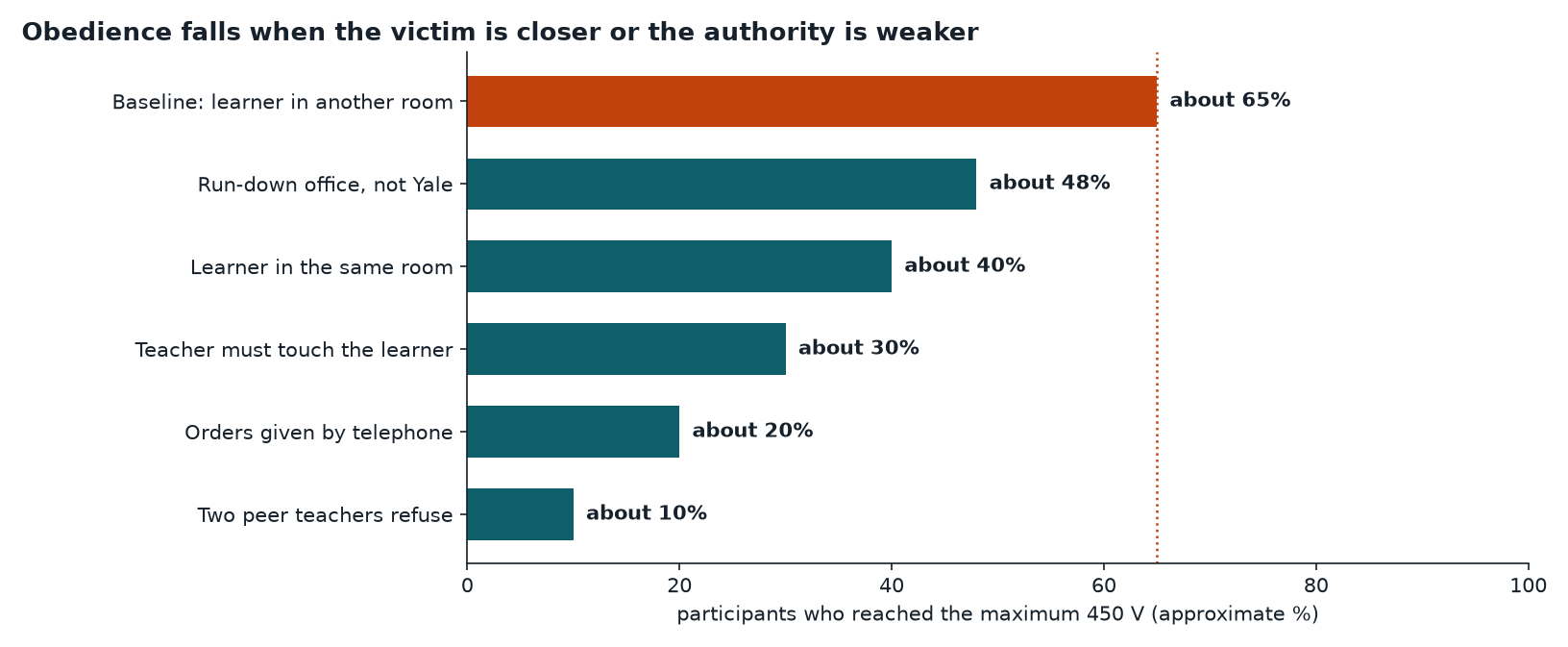
Baseline result: 26 of 40 participants, or 65 percent, continued to the maximum 450 volts. None stopped before 300 volts. Many showed visible stress while continuing.
What lowered obedience (approximate rates from Milgram's variations):
- Closer victim. Seating the learner a few feet from the teacher dropped full obedience to about 40 percent. Requiring the teacher to physically hold the learner's hand on a shock plate lowered it to about 30 percent.
- Distant authority. When the experimenter gave orders by telephone, obedience fell to about 20 percent.
- Defiant peers. When two other "teachers" (confederates) refused to continue, only about 10 percent of participants went to 450 volts.
- Less prestige. Moving the study from Yale to a run-down office building lowered obedience only modestly, to just under half.
Why people obeyed
Milgram proposed the agentic state: people come to see themselves as instruments carrying out another person's wishes, so they shift responsibility to the authority. Several features made obedience easier: the authority looked legitimate (a scientist at a respected university), the shocks rose in small steps so each new step felt like only a little more, and the victim was out of sight.
A more recent interpretation, from Alex Haslam and Stephen Reicher, argues that participants were not mindless but engaged followers who continued because they identified with the scientific goal. Jerry Burger's 2009 partial replication stopped at 150 volts for ethical reasons and still found high rates of continuing to that point.
Ethics. The studies relied on deception and caused real distress, and they helped motivate modern requirements for informed consent, the right to withdraw, and debriefing.
Worked example: separating normative and informational effects
A lab runs a line-judgment task with 50 participants and 12 critical trials each, so 600 critical answers in total.
- Public answers, unanimous majority of five: 186 of 600 answers conform. That is 186 / 600 = 31 percent.
- Same setup, private written answers: 66 of 600 conform, which is 11 percent.
- Public answers, one confederate dissents: 48 of 600 conform, which is 8 percent.
Reading the numbers:
- Going private cut the rate by 31 minus 11 = 20 percentage points. Pressure that disappears when no one is watching is normative, so most of the public conformity was the wish to fit in.
- The 11 percent that survived in private suggests some participants genuinely doubted their own eyes, a smaller informational component.
- One dissenter dropped the rate from 31 to 8 percent, a fall of 23 points, or about 74 percent of the original rate (23 / 31). Breaking unanimity matters more than the size of the majority.
These are made-up numbers for practice, but the pattern matches the direction of Asch's real findings.
Conformity vs obedience side by side
| Feature | Conformity (Asch) | Obedience (Milgram) |
|---|---|---|
| Pressure from | Peers of equal status | An authority figure |
| Explicit demand? | No | Yes, direct orders |
| Main motive | Acceptance or information | Responsibility shifted to the authority |
| Baseline rate | About a third of critical answers | About two thirds reached 450 V |
| Biggest reducer | One dissenting ally | Closeness to victim, defiant peers |
Notice that a dissenting peer lowers both conformity and obedience. Seeing one other person refuse makes resistance feel possible. This is also a lesson in attribution: observers tend to predict that only cruel people would continue, underestimating the power of the situation, a pattern described in the fundamental attribution error.
Common traps
- Calling Milgram a conformity study. The experimenter gave orders, so it is obedience. Conformity has no direct command.
- Saying most Asch answers conformed. About a third of critical answers did. Roughly 75 percent gave in on one or more trials, which is a different statistic.
- Thinking anyone was shocked. The learner was a confederate and no shocks were delivered.
- Assuming a bigger majority always means more conformity. The effect plateaus at about three or four.
- Confusing normative with informational. Ambiguous task and private belief change point to informational; clear task and public-only agreement point to normative.
- Treating compliance and obedience as the same. Compliance answers a request from anyone; obedience answers a command from authority.
One-minute recap
- Conformity: matching peers, no explicit demand. Obedience: following an authority's command.
- Asch: about one third of critical answers conformed; roughly 75 percent of people gave in at least once; plateau near three or four confederates; one ally sharply cuts it.
- Normative influence: wanting acceptance, public only. Informational: believing others know better, can change private belief (Sherif).
- Milgram: 65 percent reached 450 V; obedience dropped with a closer victim, a remote experimenter or defiant peers.
- Agentic state: responsibility shifted to the authority.
Check yourself: 5-question mini-quiz
1. A new employee starts wearing formal clothes after noticing that all coworkers do, though no one asked her to. Is this conformity or obedience?
Conformity. The pressure comes from peers and there is no explicit command from an authority.
2. In Asch's studies, what change to the makeup of the confederate majority most sharply reduced conformity?
Breaking unanimity. A single dissenting confederate, even one giving a different wrong answer, cut conformity sharply.
3. Group members estimating how far a still light seems to move in a dark room converge on a shared answer. Which type of influence is this?
Informational influence. The task is ambiguous, so people use others' judgments as information, and the group norm can persist in private.
4. In Milgram's baseline study, roughly what share of participants reached the maximum 450 volts?
About 65 percent, 26 of 40 participants, continued to the maximum level.
5. What did Milgram call the mental shift in which participants saw themselves as carrying out the experimenter's wishes?
The agentic state. Participants transferred responsibility for their actions to the authority figure.