Free MCAT study note
Functionalism vs Conflict Theory vs Symbolic Interactionism
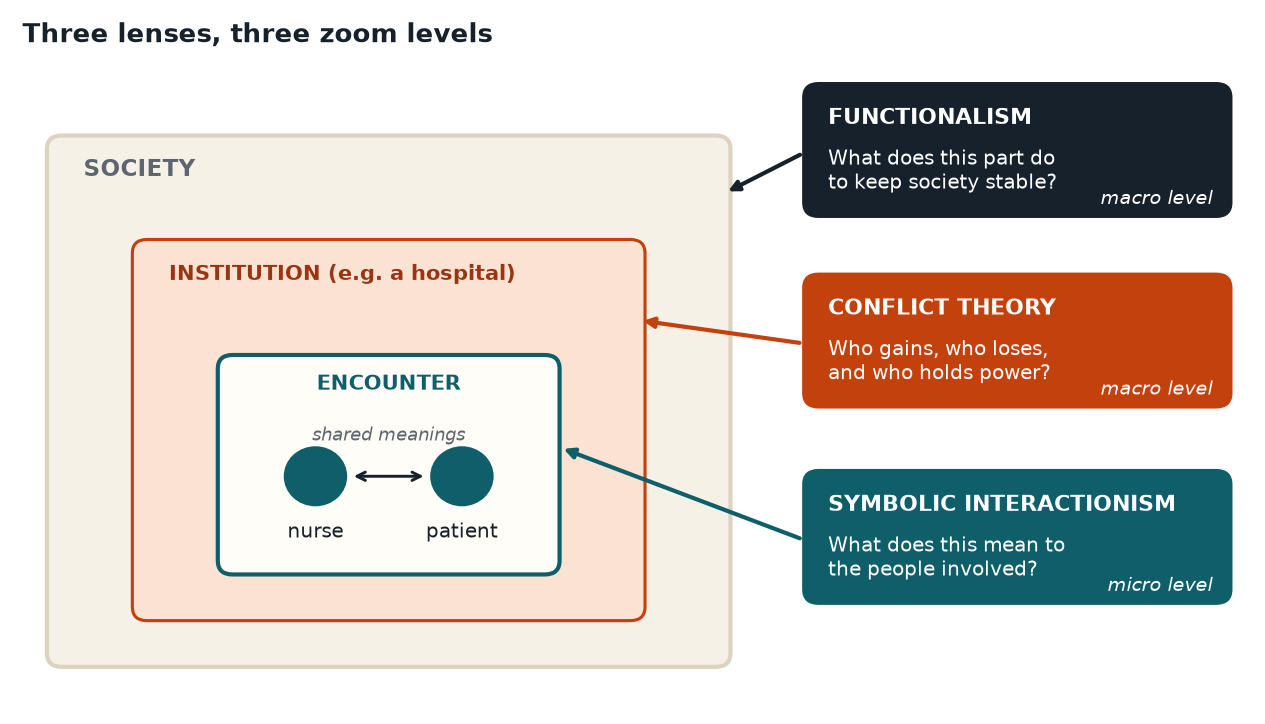
Functionalism asks how each part of society helps the whole stay stable. Conflict theory asks who gains and who loses when groups compete for scarce resources such as money, power and prestige. Symbolic interactionism asks how people create and act on shared meanings in everyday, face-to-face encounters. The fastest way to sort them is the level of analysis: functionalism and conflict theory look at whole societies and institutions (macro), while symbolic interactionism looks at individuals and small interactions (micro).
The three paradigms side by side
A paradigm is a lens, not a verdict. Each one makes certain facts easy to see and others easy to miss. Questions in this area usually describe a situation or a researcher's claim and ask which lens it reflects, so the goal is to recognize each lens by its signature question.
| Functionalism | Conflict theory | Symbolic interactionism | |
|---|---|---|---|
| Level | Macro | Macro | Micro |
| Picture of society | A system of interdependent parts | An arena of competing groups | A web of interactions and shared meanings |
| Signature question | What does this do for society? | Who benefits, and at whose expense? | What does this mean to the people involved? |
| Explains well | Stability, cohesion, why institutions persist | Inequality, power, social change | Identity, labels, everyday behavior |
| Main blind spot | Inequality and change | Cohesion and consensus | Large-scale structures and power |
| Key names | Durkheim, Parsons, Merton | Marx, Weber, Dahrendorf, Mills | Mead, Cooley, Blumer, Goffman |
Functionalism: parts that keep the whole running
Functionalism treats society the way a physiologist treats a body. Organs differ, but each contributes to keeping the organism alive. In the same way, families, schools, religion, the economy and government each meet a need, and the arrangement tends toward balance.
- Emile Durkheim laid the groundwork. He asked what holds a society together. In small traditional societies, cohesion comes from people being alike and sharing beliefs (mechanical solidarity). In large modern societies, it comes from people being different and depending on one another's specialized work (organic solidarity). When rapid change leaves people without clear norms, Durkheim called the result anomie.
- Talcott Parsons built functionalism into a large theory of social systems in the mid-twentieth century. His sick role is a functionalist idea: illness is a temporary, excused exit from normal duties, granted on the condition that the person tries to get well.
- Robert Merton sharpened the approach. Manifest functions are intended and recognized. Latent functions are unintended and usually unrecognized. Dysfunctions are effects that undermine stability.
A useful way to read Merton: "manifest vs latent" is about intention, and "function vs dysfunction" is about effect. A latent consequence can be helpful or harmful.
Conflict theory: competition over scarce resources
Conflict theory sees society as held together less by agreement than by power. Groups with more resources shape institutions in ways that protect their position, and tension between groups drives change.
- Karl Marx centered class. The bourgeoisie own the means of production, and the proletariat sell their labor. Workers who recognize their shared interests have class consciousness; workers who accept ideas that hide their exploitation have false consciousness.
- Max Weber argued that stratification has more than one dimension: class (economic position), status (social honor or prestige) and party (political power). Someone can rank high on one and low on another. He is also known for work on bureaucracy and types of authority, but for paradigm questions his three dimensions place him in the conflict tradition.
- Ralf Dahrendorf shifted the focus from ownership to authority: in any organization, those who give orders and those who take them have opposed interests.
- C. Wright Mills described a power elite of top corporate, military and political leaders whose decisions shape the lives of everyone else.
Feminist theory and critical race theory grew partly from the same root: they ask how gender or race, rather than class alone, structure who holds power.
"Conflict" does not require open fighting. A quiet admissions rule that favors applicants with expensive test preparation is a conflict theory topic, because it is about unequal access to a scarce reward.
Symbolic interactionism: meaning made face to face
Symbolic interactionism starts small. People do not respond to objects and actions directly; they respond to what those things mean, and meanings are built and revised through interaction.
- George Herbert Mead developed the core ideas, including the self as made of the spontaneous I and the socialized me, and the generalized other, the sense of what society as a whole expects.
- Herbert Blumer, who carried Mead's ideas forward at the University of Chicago, coined the name "symbolic interactionism" in 1937 and summarized its premises: people act toward things based on their meanings, meanings come from social interaction, and meanings are modified through interpretation.
- Charles Horton Cooley described the looking-glass self: we imagine how we appear to others, imagine how they judge us, and feel pride or shame as a result.
- Erving Goffman's dramaturgy treats social life as a performance, with a front stage where we manage impressions and a back stage where we relax.
- The Thomas theorem: if people define situations as real, they are real in their consequences. Labeling theory applies this to deviance: being labeled deviant can push a person toward a deviant identity.
Worked example: one ceremony, three lenses
Take a familiar event: a medical school white coat ceremony, where first-year students put on a short white coat in front of family and faculty.
Functionalist reading. The ceremony's manifest function is to welcome students and mark their entry into the profession. Its latent functions might include building bonds among classmates who barely know one another and reassuring families about the investment they are making. Rituals like this transmit professional norms and integrate newcomers, which helps the institution of medicine reproduce itself across generations.
Conflict reading. Who is on that stage? Reaching it takes years of costly preparation, application fees, unpaid research experience and, often, family connections in medicine. A conflict theorist would ask how gatekeeping protects the profession's status and income, and why some groups are underrepresented among the students in the coats.
Interactionist reading. The coat is a symbol. A student who puts it on may start to see themselves as a physician-in-training and to act the part, and patients may treat the student with new trust because of what the coat signals. This is the looking-glass self and impression management at work: identity forms through how others respond.
Notice that the facts never changed. Each lens chose different facts to care about.
Classify these five claims
- "Rising rates of divorce reflect a mismatch between older family norms and a changing economy, and new norms will eventually restore balance." Functionalism (balance, norms adjusting).
- "Landlords and developers shape zoning law so that low-income residents absorb the costs of urban growth." Conflict theory (groups competing over a scarce resource).
- "A student told she is 'not a math person' begins to avoid math classes." Symbolic interactionism (a label changes self-concept and behavior).
- "Organized sports teach cooperation and give communities a shared identity." Functionalism (what the institution does for cohesion).
- "Nurses on a ward develop a private joking style they never use in front of patients." Symbolic interactionism (back stage vs front stage).
Common traps
- Judging level by the size of the example. A conflict theory claim about a single hospital is still macro in spirit, because it is about group interests and institutional power. A label applied in one classroom is micro because it is about meaning in interaction.
- Equating "latent" with "bad." Latent means unintended. A latent function can be helpful; a harmful effect is a dysfunction.
- Assigning Weber's class, status and party to Marx. Marx focused on ownership of the means of production. The three dimensions are Weber's.
- Reading every inequality mention as conflict theory. Ask what the author says inequality does. If the author says unequal rewards motivate talented people to fill important jobs (the Davis-Moore argument), that is functionalism.
- Confusing interactionism with social constructionism. They overlap. Interactionism emphasizes meaning negotiated in specific encounters; social constructionism emphasizes how whole categories, such as money or adolescence, come to be treated as objective facts.
- Forgetting the critiques. A critique that a theory "ignores inequality" or "cannot explain change" targets functionalism. A critique that a theory "neglects social cohesion" targets conflict theory. A critique that it "ignores large-scale structures" targets interactionism.
Related lenses you should recognize
Three more paradigms often appear next to these: social constructionism (reality as shared agreement), rational choice and exchange theory (people weigh rewards against costs), and feminist theory (gender inequality built into institutions). Inequality topics such as class systems and mobility draw heavily on conflict and functionalist thinking; see types of social mobility and stratification for how both lenses explain why rewards are unequal.
One-minute recap
- Functionalism: macro, society as interdependent parts, stability. Durkheim, Parsons, Merton. Manifest vs latent functions, dysfunctions.
- Conflict theory: macro, groups compete for scarce resources, inequality and change. Marx, Weber (class, status, party), Dahrendorf, Mills.
- Symbolic interactionism: micro, meanings built in interaction. Mead, Blumer, Cooley, Goffman. Looking-glass self, dramaturgy, Thomas theorem, labeling.
- To classify a claim, ask: is it about stability, about power, or about meaning?
Check yourself: 5-question mini-quiz
1. A researcher argues that public schools mainly sort students into future occupations in a way that preserves the advantages of wealthy families. Which paradigm is this?
Conflict theory. The claim is about an institution protecting the position of a powerful group, not about stability or individual meaning.
2. Which paradigm works at the micro level: functionalism, conflict theory or symbolic interactionism?
Symbolic interactionism. It studies how individuals create and respond to meanings in face-to-face interaction, while the other two analyze whole societies and institutions.
3. A summer camp's stated purpose is outdoor education, but it also gives working parents several weeks of child care. In Merton's terms, what is the child care?
A latent function. It is an unintended, usually unrecognized consequence that still helps the system, so it is not a dysfunction.
4. Who proposed that stratification has three separate dimensions of class, status and party?
Max Weber. Marx defined class by ownership of the means of production, while Weber added prestige (status) and political power (party).
5. A critic says a theory "cannot explain why societies change and overlooks inequality." Which paradigm is most likely being criticized?
Functionalism. Its focus on stability and the contributions of each part is the source of this standard critique.