Free MCAT study note
Fundamental Attribution Error vs Actor-Observer vs Self-Serving Bias
All three biases are mistakes in attribution, the explanations people give for behavior. The fundamental attribution error is overestimating personality and underestimating the situation when explaining other people's behavior. The actor-observer bias is the contrast between how we explain our own behavior (situation) and others' behavior (personality). The self-serving bias depends on the outcome: we credit ourselves for successes and blame circumstances for failures. To tell them apart, ask two questions: whose behavior is being explained, and was the outcome good or bad?
The basic choice: dispositional vs situational
Fritz Heider, whose 1958 book laid the groundwork for attribution research, described people as everyday scientists trying to explain why things happen. Every explanation falls on a spectrum between two poles:
- Dispositional (internal) attribution: the cause is something about the person. Traits, abilities, effort, attitudes. "He was late because he is careless."
- Situational (external) attribution: the cause is something about the circumstances. Traffic, luck, task difficulty, other people. "He was late because the bridge was closed."
Every bias in this note is a systematic tilt toward one pole or the other.
Fundamental attribution error
Definition: when judging other people, we lean too hard on dispositional explanations and give too little weight to the situation. The term was coined by Lee Ross in 1977.
Example: a cashier is curt with you, and you conclude she is a rude person. You do not see that she has been on her feet for nine hours and the customer before you shouted at her.
Classic evidence: in a 1967 study by Jones and Harris, participants read essays that either supported or opposed Fidel Castro. Even when told the writer had been assigned which side to argue, participants still judged that the writer personally held the view in the essay. The situational constraint was known and still underused.
Why it happens:
- Perceptual salience. When you watch someone, the person is the most visible thing in the scene. The pressures acting on them are often invisible.
- Effortful correction. One influential account says people first make a quick dispositional judgment and only then adjust for the situation, and that the adjustment takes mental effort. Tired, rushed or distracted observers adjust less.
- Culture. The error is stronger in individualistic cultures, which emphasize the person as an independent agent. People raised in collectivistic cultures tend to weigh situational and social context more heavily. The bias is not absent there, but it is weaker, which is one reason "fundamental" is considered an overstatement.
Actor-observer bias
Definition: as the actor, we explain our own behavior situationally. As the observer, we explain other people's behavior dispositionally. Jones and Nisbett proposed it in 1971.
Example: when you cut someone off in traffic, it is because you were about to miss your exit. When someone cuts you off, it is because they are a reckless driver.
Why it happens: perspective. As the actor, you see the situation and not yourself; as the observer, you see the person and not their situation. You also know your own history across many settings, so you know your behavior varies, while you see a stranger in one moment only.
How it relates to the fundamental attribution error: the fundamental attribution error is the observer half of this pattern. The actor-observer bias adds the comparison with how we explain ourselves.
A note on evidence: the actor-observer asymmetry is less robust than many study guides suggest. A large 2006 meta-analysis by Bertram Malle found little support for a general version of it, with the asymmetry appearing only under certain conditions. For test questions, use the standard definition, but do not be surprised if a passage describes it as contested.
Self-serving bias
Definition: we attribute our successes to dispositional causes (skill, effort) and our failures to situational causes (bad luck, unfair tests, other people).
Example: after acing an exam, a student says she studied hard. After failing the next one, she says the questions were tricky and the room was too cold.
Why it happens: protecting self-esteem is the main explanation. Taking credit for good outcomes feels good, and blaming the situation for bad ones softens the blow.
Where it clashes with actor-observer bias: for your own success, the actor-observer bias predicts a situational explanation, but the self-serving bias predicts a dispositional one. In practice, the self-serving pattern usually wins for outcomes people care about. On a test question, the deciding detail is whether the outcome is described as a success or a failure. If it is, think self-serving. If the passage stresses the contrast between how someone explains themselves vs others, think actor-observer.
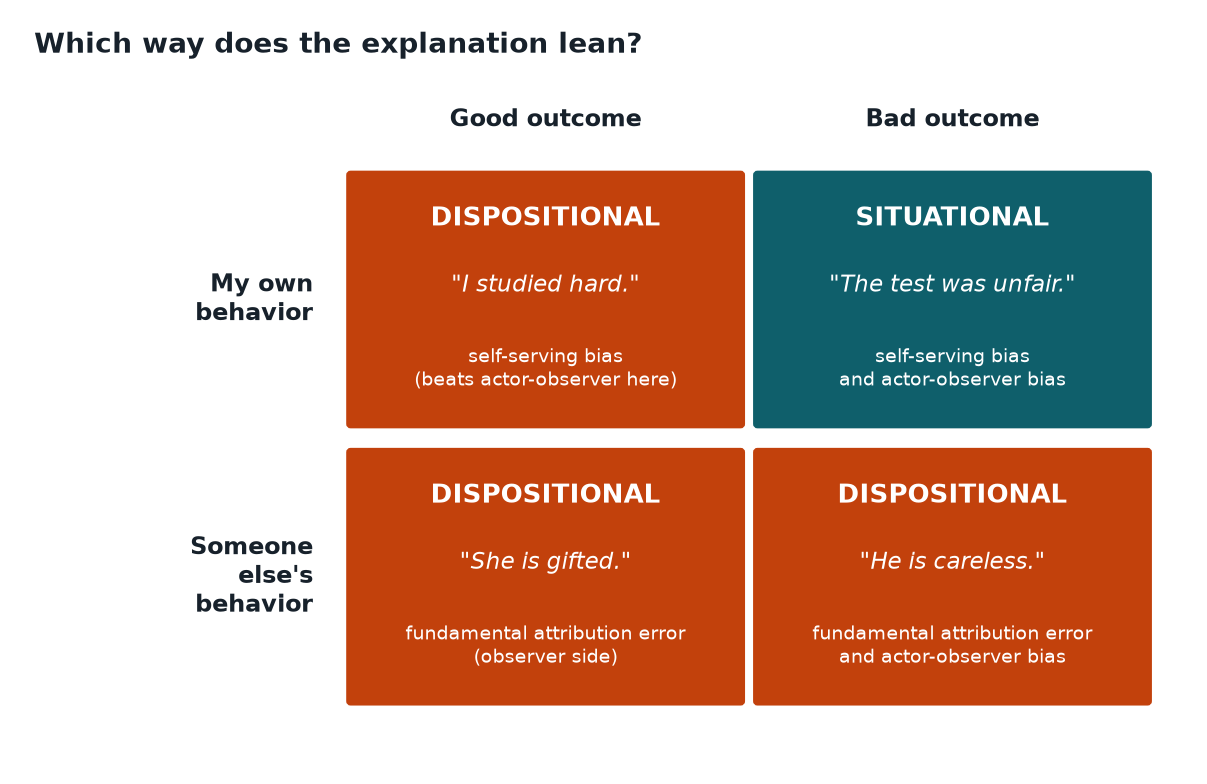
Side-by-side comparison
| Bias | Whose behavior | Prediction | Key driver |
|---|---|---|---|
| Fundamental attribution error | Others | Too much disposition, too little situation | Salience, effortful correction |
| Actor-observer bias | Self vs others | Self: situation. Others: disposition | Perspective |
| Self-serving bias | Self | Success: disposition. Failure: situation | Protecting self-esteem |
Kelley's covariation model: how attributions should work
Harold Kelley proposed that people decide between dispositional and situational causes by checking three kinds of information. Suppose Maya laughs at a particular comedian.
| Cue | Question | High means |
|---|---|---|
| Consensus | Do other people respond the same way to this comedian? | Most people laugh |
| Distinctiveness | Does Maya respond this way only to this comedian? | She rarely laughs at other comedians |
| Consistency | Does Maya respond this way to this comedian every time? | She laughs at every show |
Reading the pattern:
- High consensus, high distinctiveness, high consistency: situational (the comedian really is funny).
- Low consensus, low distinctiveness, high consistency: dispositional (Maya laughs at everything).
- Low consistency: the behavior is a one-off, so people tend to credit the particular circumstances of that occasion.
Worked example with numbers
Two scenarios, each with 10 friends watching the same comedian.
Scenario A. 9 of 10 friends laugh (consensus 90%, high). Maya laughed at 1 of the last 8 comedians she saw (she laughs at few others, so distinctiveness is high). She laughed at this comedian at all 3 of his shows (consistency 3/3, high). Pattern: high, high, high. Situational attribution: the comedian is funny.
Scenario B. 1 of 10 friends laughs (consensus 10%, low). Maya laughed at 7 of the last 8 comedians (distinctiveness low, she laughs at nearly everyone). She laughed at all 3 shows (consistency high). Pattern: low, low, high. Dispositional attribution: Maya laughs easily.
The trap in Scenario B is to focus on the 3/3 consistency. Consistency is high in both scenarios, so it cannot separate them. Consensus and distinctiveness do the work.
Related errors that show up nearby
- Just-world hypothesis: believing people get what they deserve. It pushes observers toward blaming victims, a dispositional attribution for misfortune.
- Halo effect: one positive trait, such as attractiveness, colors judgments of unrelated traits, such as intelligence.
- Group-level attributions: people often extend the self-serving pattern to their in-group, crediting the in-group's successes to its qualities and blaming the out-group's successes on luck or special treatment. This version is sometimes called the ultimate attribution error.
- Optimism bias: believing bad events are less likely to happen to you than to others.
Common traps
- Calling any self-flattering explanation the fundamental attribution error. That error is about judging others. Self-flattery is self-serving bias.
- Forgetting the outcome. If the scenario hinges on success vs failure, the self-serving bias is the likely answer.
- Thinking dispositional explanations are always wrong. The error is relative: too much weight on disposition when the situation deserves more.
- Mixing up distinctiveness and consistency. Distinctiveness compares across different targets. Consistency compares across time with the same target.
- Assuming the fundamental attribution error is universal and equal across cultures. It is weaker in collectivistic cultures.
One-minute recap
- Dispositional = person. Situational = circumstances.
- Fundamental attribution error: others' behavior gets too much dispositional explanation.
- Actor-observer bias: self explained by situation, others by disposition. Driven by perspective.
- Self-serving bias: my success is me, my failure is the situation. Driven by self-esteem.
- Kelley: high consensus + high distinctiveness + high consistency points to the situation; low + low + high points to the person.
- Individualistic cultures show a stronger fundamental attribution error than collectivistic cultures.
Check yourself: 5-question mini-quiz
1. A manager assumes a new employee is lazy after she misses a deadline, without learning that her computer crashed. Which bias is this?
The fundamental attribution error. The manager overweights a dispositional cause (laziness) and underweights the situation when judging someone else.
2. A runner says she won the race because of her training and lost the next one because of a headwind. Which bias best fits?
Self-serving bias. She credits success to herself (dispositional) and blames failure on circumstances (situational).
3. Most people find a professor confusing, a student finds only this professor confusing, and he finds her confusing every lecture. What attribution does Kelley's model predict?
Situational, about the professor. High consensus, high distinctiveness and high consistency point to the stimulus rather than the student.
4. A driver explains his own speeding by being late for a flight but calls other speeders reckless. Which bias is this?
Actor-observer bias. As the actor he cites the situation, and as the observer he cites the other drivers' dispositions.
5. Would the fundamental attribution error be expected to be stronger in an individualistic or a collectivistic culture?
Individualistic. Those cultures emphasize personal traits as causes of behavior, while collectivistic cultures give more weight to situational and social context.