Free MCAT study note
Gibbs Free Energy: Delta G, Spontaneity and Temperature
Gibbs free energy tells you whether a process can happen on its own at constant temperature and pressure. The working equation is ΔG = ΔH - TΔS. If ΔG is negative the process is spontaneous (exergonic), if it is positive the process is nonspontaneous as written (endergonic) and the reverse direction is favored, and if it is zero the system is at equilibrium. Spontaneous means thermodynamically allowed. It says nothing about speed.
Where the equation comes from
The second law says a process is spontaneous when the total entropy of the universe rises: ΔSuniverse = ΔSsystem + ΔSsurroundings > 0. Measuring the surroundings directly is awkward, so chemists rewrite their entropy change in terms of the system.
At constant pressure, heat released by the system equals heat absorbed by the surroundings, so ΔSsurroundings = -ΔHsystem/T. Substituting gives ΔSuniverse = ΔS - ΔH/T. Multiply through by -T and you get -TΔSuniverse = ΔH - TΔS, which is defined as ΔG. Because of that minus sign, a positive ΔSuniverse becomes a negative ΔG. So "ΔG less than zero" is just the second law written using only properties of the system.
This derivation also explains why an exothermic reaction can be spontaneous even when the system's entropy falls. The heat it releases raises the entropy of the surroundings, and at low enough temperature that gain outweighs the system's loss.
The four sign combinations
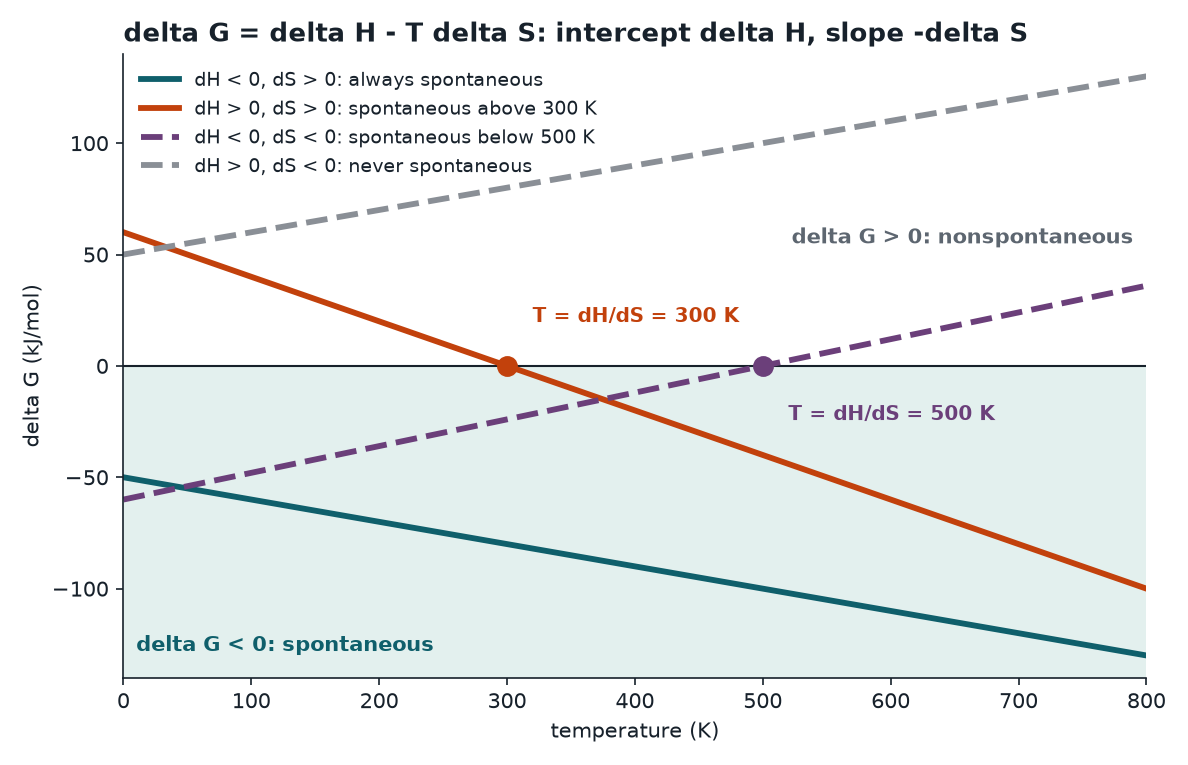
ΔH and ΔS are each either positive or negative, so there are four cases. Temperature is always positive in kelvin, so the -TΔS term always has the opposite sign of ΔS.
| ΔH | ΔS | Sign of ΔG | Spontaneous when |
|---|---|---|---|
| Negative | Positive | Always negative | At every temperature |
| Positive | Negative | Always positive | Never (the reverse is always spontaneous) |
| Positive | Positive | Negative only if TΔS beats ΔH | Above the crossover temperature |
| Negative | Negative | Negative only if ΔH beats TΔS | Below the crossover temperature |
A memory hook of my own: in the two mixed cases, temperature takes the side of entropy. When entropy helps (ΔS positive), heating helps. When entropy hurts (ΔS negative), heating hurts.
The crossover temperature
When ΔH and ΔS have the same sign, ΔG changes sign at one temperature. Set ΔG = 0 and solve:
T = ΔH / ΔS
This is the temperature where the system is at equilibrium under standard conditions. For a phase change, it is the melting or boiling point. The estimate assumes ΔH and ΔS stay roughly constant with temperature, which is a reasonable approximation over a modest range.
Graphically, ΔG = ΔH - TΔS is a straight line in T with y-intercept ΔH and slope -ΔS. A positive ΔS gives a line that falls as temperature rises, and a negative ΔS gives a line that climbs.
Worked example 1: melting ice
For H2O(s) → H2O(l), approximate values are ΔH = +6.01 kJ/mol and ΔS = +22.0 J/(mol·K). Both are positive, so melting is favored only at high temperature.
- Convert units so they match: 22.0 J/(mol·K) = 0.0220 kJ/(mol·K).
- Crossover: T = 6.01 / 0.0220 = 273 K, the normal melting point. The equation reproduces a number you already know, which is a good sanity check.
- At 263 K (-10 C): ΔG = 6.01 - (263)(0.0220) = 6.01 - 5.79 = +0.22 kJ/mol. Positive, so ice does not melt, and the reverse, freezing, is spontaneous.
- At 283 K (+10 C): ΔG = 6.01 - (283)(0.0220) = 6.01 - 6.23 = -0.22 kJ/mol. Negative, so ice melts.
Worked example 2: decomposing limestone
Calcium carbonate breaks down to lime and carbon dioxide: CaCO3(s) → CaO(s) + CO2(g). Using approximate standard values ΔH° = +178 kJ and ΔS° = +161 J/K:
- The reaction makes a mole of gas from a solid, so a large positive ΔS makes sense. Breaking the carbonate costs energy, so ΔH is positive.
- At 298 K: ΔG° = 178 - (298)(0.161) = 178 - 48 = +130 kJ. Strongly nonspontaneous at room temperature, which is why limestone buildings survive.
- Crossover: T = 178 / 0.161, about 1106 K, or roughly 830 C. Above that temperature the decomposition becomes favorable under standard conditions, which is why lime kilns run very hot.
Treat the 1106 K figure as an estimate, since ΔH and ΔS drift somewhat at high temperature.
Standard versus actual free energy
The degree symbol matters. ΔG° is the free energy change when every species is in its standard state: 1 M for solutes, 1 atm for gases, pure solids and liquids, at a stated temperature (often 298 K). ΔG is the free energy change under the conditions actually present. They are linked by the reaction quotient Q:
ΔG = ΔG° + RT ln Q
At equilibrium, ΔG = 0 and Q = K, which gives the second key equation:
ΔG° = -RT ln K
With R = 8.314 J/(mol·K) and T = 298 K, RT ln 10 is about 5.7 kJ/mol. So at room temperature every factor of 10 in K shifts ΔG° by about 5.7 kJ/mol, and the sign rules line up:
| K | ΔG° | At standard conditions |
|---|---|---|
| Greater than 1 | Negative | Products favored |
| Equal to 1 | Zero | Neither side favored |
| Less than 1 | Positive | Reactants favored |
In biochemistry you will also see ΔG°', the standard value adjusted to pH 7. Cells rarely sit at standard concentrations, so the actual ΔG inside a cell can differ a lot from either standard value.
Worked example 3: from ΔG° to K and Q
A reaction A → B has ΔG° = -11.4 kJ/mol at 298 K.
- Find K. log K = 11.4 / 5.7 = 2.0, so K is about 100. Products are favored at equilibrium.
- Mixture with Q = 1000. ΔG = -11.4 + (2.48)(ln 1000) = -11.4 + (2.48)(6.91) = -11.4 + 17.1 = +5.7 kJ/mol. (Here RT = 2.48 kJ/mol.) Even though ΔG° is negative, this mixture has too much B, so the reaction runs in reverse toward A.
- Shortcut. ΔG = RT ln(Q/K) = (2.48)(ln 10) = 5.7 kJ/mol. Q is ten times K, so the mixture sits one factor of 10 past equilibrium on the product side.
The lesson: the sign of ΔG° tells you where equilibrium lies, but the sign of ΔG tells you which way a particular mixture will move.
Free energy adds up
Because G is a state function, ΔG values for reactions that add together also add together. Cells exploit this by coupling an unfavorable step to a favorable one through a shared intermediate. If a step has ΔG°' = +20 kJ/mol and it is coupled to ATP hydrolysis (about -30.5 kJ/mol under biochemical standard conditions), the combined process has ΔG°' of about -10.5 kJ/mol and proceeds. The same bookkeeping shows up in membrane transport, where pumping a solute uphill is paid for by ATP, as worked through in the transport note.
Free energy also connects to electrochemistry through ΔG = -nFE. A positive cell potential corresponds to a negative ΔG, which is why a battery runs on its own. The galvanic vs electrolytic note uses that link.
Common traps
- Mixing joules and kilojoules. ΔS is usually tabulated in J/K and ΔH in kJ. Convert one before you combine them. Forgetting this makes TΔS a thousand times too large.
- Using Celsius. T must be in kelvin. A negative Celsius temperature in the equation gives nonsense.
- Equating exothermic with spontaneous. A negative ΔH helps, but a large negative ΔS can still make ΔG positive at high temperature.
- Equating spontaneous with fast. ΔG says nothing about activation energy. Diamond turning into graphite is favorable at room conditions and essentially never observed. A catalyst speeds a reaction without changing ΔG or K.
- Confusing ΔG with ΔG°. At equilibrium ΔG = 0, but ΔG° is generally not zero. ΔG° is zero only when K = 1.
- Reading a positive ΔG° as "cannot happen." If Q is small enough, RT ln Q can make ΔG negative and the reaction will run forward.
One-minute recap
ΔG = ΔH - TΔS. Negative means spontaneous, positive means the reverse is favored, zero means equilibrium. With ΔH negative and ΔS positive the process is always spontaneous; with the opposite signs, never. When the signs match, the crossover temperature T = ΔH/ΔS divides the two regimes, and temperature sides with entropy. ΔG = ΔG° + RT ln Q, ΔG° = -RT ln K, and at 298 K each factor of 10 in K is about 5.7 kJ/mol. Convert J to kJ and use kelvin.
Check yourself: 5-question mini-quiz
1. A reaction has ΔH = -40 kJ/mol and ΔS = -0.080 kJ/(mol·K). Above what temperature is it nonspontaneous?
T = ΔH/ΔS = (-40)/(-0.080) = 500 K. Both signs are negative, so the reaction is spontaneous below 500 K and nonspontaneous above it.
2. Why can an exothermic reaction with a negative ΔS still be spontaneous at low temperature?
The released heat raises the entropy of the surroundings by -ΔH/T, which is large when T is small. If that gain exceeds the system's loss, ΔS of the universe is positive and ΔG is negative.
3. A reaction has K = 0.001 at 298 K. What is the sign and approximate size of ΔG°?
K is three factors of 10 below 1, so ΔG° is about +3 × 5.7 = +17 kJ/mol. Positive ΔG° matches K less than 1.
4. A reaction has a negative ΔG°, but a particular mixture has Q greater than K. Which way does that mixture react?
In reverse, toward reactants. ΔG = RT ln(Q/K) is positive when Q exceeds K, regardless of the sign of ΔG°.
5. Adding a catalyst lowers a reaction's activation energy. What happens to ΔG and K?
Neither changes. A catalyst speeds both directions equally, so the system reaches the same equilibrium faster.