Free MCAT study note
How to Approach a CARS Passage: A Step-by-Step Method
To approach a CARS passage, read for structure, not facts. As you read, write a few words per paragraph naming what that paragraph does (states a common view, objects, concedes, gives an example). When you finish, say the main idea in one sentence that includes the author's attitude. Then, for each question, identify what the stem is asking, predict an answer from the passage before looking at the choices, and eliminate choices by naming the specific flaw in each. Budget about 10 minutes per passage and move on from any single question that stalls.
Why structure beats detail
CARS passages come from the humanities and social sciences, and every question can be answered from the passage alone. You do not need outside knowledge about the topic, and outside knowledge can actively hurt, because a choice that is true in the real world but unsupported by the passage is still wrong.
That changes how you should read. Details are easy to find again when a question points to them: a question about the third paragraph sends you to the third paragraph in seconds. What you cannot find quickly is the shape of the argument: which view the author holds, which views the author is reporting in order to reject, and where the author softens or turns. That shape only comes from a first read done with attention. If you spend the first read memorizing facts, you will reread anyway, and you will still not know the author's position.
The method, step by step
Before you read: a two-second check
Glance at the clock against your checkpoint (see timing below). Do not skim the questions first. With five to seven questions per passage, previewing stems costs time and fills your head with fragments before you know what the passage is about.
Step 1: read actively and map each paragraph
After each paragraph, pause and write a short note, about 3 to 6 words, that names the paragraph's job. Useful job labels:
- "common view" or "others' view"
- "author's claim" or "author objects"
- "evidence: study" or "example"
- "concession" (the author grants something)
- "rebuttal" (the author answers an objection)
- "recommendation" or "conclusion"
While reading, watch for two kinds of words:
- Pivot words such as but, yet, however, still and nevertheless. The sentence after a pivot usually carries the author's real point.
- Evaluative words, the adjectives, adverbs and verbs that reveal judgment: misguided, admirable, merely, rightly, overlooks. These are your evidence for tone.
Step 2: name the main idea, with attitude
Before opening the questions, say in one sentence what the author is arguing and how they feel about it. "The passage is about maps" is a topic. "The author argues that every map distorts, so maps should be judged by their purpose, and is mildly critical of readers who treat maps as neutral" is a main idea. If you cannot produce that sentence, reread the first and last paragraphs, since many authors open with a view they intend to challenge and close with what they actually think.
Step 3: decode the question stem
Questions sort into three broad families:
| Family | What it asks | Stem cues |
|---|---|---|
| Comprehension | What the passage says or means | "According to the passage," "the author's main point," "as used in the passage, the word" |
| Reasoning within the text | What follows from it, or why something is there | "suggests," "implies," "the author mentions X in order to," "assumes" |
| Reasoning beyond the text | How the passage's ideas apply to new information | "Suppose," "if it were found that," "which new situation is most similar," "most weakens" |
Knowing the family tells you where to look. Comprehension answers sit in specific lines. Within-the-text answers sit one small step beyond those lines. Beyond-the-text answers require you to state the passage's principle in general terms first, then test the new case against it.
Step 4: predict, then compare
Before reading the choices, form a rough answer in your own words. It does not need to be precise; "something like: the author would say it depends on purpose" is enough. A prediction protects you from choices engineered to sound right. Then read all four choices and look for the one that matches your prediction in meaning, not in wording.
Step 5: eliminate by naming the flaw
Strike a choice only when you can name what is wrong with it. The usual flaws:
- Too extreme: always, never, only, proves, entirely, when the passage hedges.
- Out of scope: brings in a group, era, or topic the passage never addresses.
- Reversed: flips a cause and effect, or a more and a less.
- Half right: the first part matches the passage, the last few words do not. Read every choice to the end.
- True but irrelevant: accurately reflects the passage, but does not answer this question.
- Wrong voice: states a view the author reports but does not hold.
If two choices survive, find the exact word or phrase where they differ and check that point against the passage. Then commit and move on.
Worked example: a short passage, mapped and answered
Here is a compact passage written for practice. Real passages are longer, but the method is the same.
P1. Most people assume a good map is simply an accurate one, a faithful picture of the ground shrunk to fit a page.
P2. Yet no flat map can be faithful to a round planet. Flattening a sphere forces a trade: a projection can keep the shapes of small areas true, or keep sizes in proportion, but not both at once. Every world map is therefore a decision about which truth to give up.
P3. Admittedly, some decisions serve particular users well. The Mercator projection keeps compass directions straight, which made it valuable to navigators, even though it inflates regions near the poles so that Greenland looks roughly as large as Africa, a continent about fourteen times its size.
P4. The lesson is not that some maps lie and others tell the truth. It is that a reader should ask what a map was made to do before trusting what it seems to show.
Map.
- P1: common view: map = accurate
- P2: author objects: all flat maps distort
- P3: concession: Mercator useful for navigation
- P4: conclusion: judge a map by its purpose
Tone: measured, mildly critical of the common view. Main idea: because every flat map trades one kind of accuracy for another, readers should judge maps by their purpose rather than treat any map as neutral.
Notice the job labels. "Yet" at the start of P2 marks the turn from the common view to the author's. "Admittedly" in P3 signals a concession, and the author returns to the main argument in P4.
Question. Based on the passage, the author would most likely agree that:
- A. The Mercator projection should no longer be used.
- B. Evaluating a map requires knowing the purpose it was designed for.
- C. Maps that keep sizes in proportion are the most accurate kind of map.
- D. Most readers do not understand how map projections work.
Prediction: the author's own conclusion in P4, roughly "judge a map by what it was made to do."
Elimination:
- A is too extreme and contradicts the concession: the author grants that Mercator served navigators well.
- C reverses the argument: the author says every projection gives up some truth, so no single kind is simply the most accurate.
- D is out of scope: the passage discusses an assumption people make about maps, not what most readers understand about projections.
- B matches the prediction and restates P4. Answer: B.
The whole question took one prediction and three named flaws. That is the pace you want.
Timing: a plan you can check
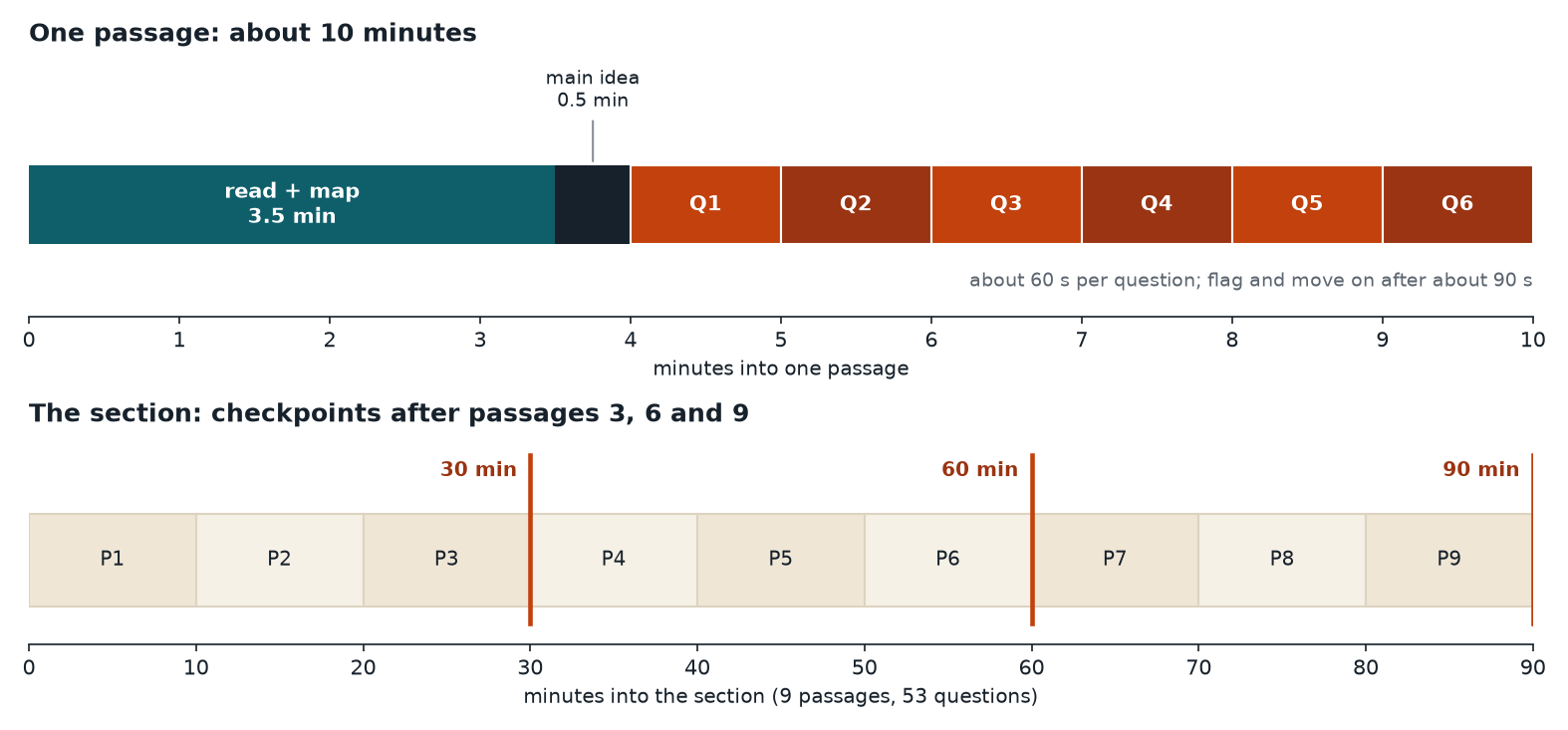
The section gives you 90 minutes for 9 passages and 53 questions, so the average budget is 10 minutes per passage. A workable split is about 3 to 4 minutes to read and map and the rest for questions.
Some quick arithmetic with that plan:
- With 3.5 minutes of reading and 0.5 minutes to state the main idea, a 6-question passage leaves 6 minutes for questions, or 60 seconds each.
- Checkpoints every three passages: about 30 minutes after passage 3, 60 after passage 6, 90 after passage 9.
- If you reach the first checkpoint at 34 minutes, you are 4 minutes behind. Spread across the six passages left, that is 40 seconds to recover per passage, which you can do by moving on from stuck questions sooner, not by reading carelessly.
Every question is worth the same, and a wrong answer costs nothing extra compared with a blank. So if a question has taken about 90 seconds with no progress, pick your best remaining choice, flag it, and move on. Never leave a blank at the end.
Common traps
- Treating the first paragraph's view as the author's. Many passages open with a position the author will challenge. Look for the pivot.
- Mapping facts instead of jobs. A note like "Mercator 1569 navigation" is a detail; "concession" is a job, and jobs answer questions.
- Reading the choices before predicting. Wrong choices are written to be attractive; a prediction is your defense.
- Choosing an answer because it repeats passage words. Matching vocabulary is a common feature of wrong answers. Match meaning instead.
- Striking every absolute word automatically. An absolute choice is correct when the passage itself makes an absolute claim. Check the text.
- Using outside knowledge. If the passage does not support it, it is not the answer, even if it is true.
- Rereading the whole passage for one question. Use your map to jump to the right paragraph.
- Reviewing only the answer letter afterward. When you review practice, write down the question type, the flaw that fooled you and a rule for next time.
One-minute recap
- Read for structure: one 3 to 6 word job label per paragraph.
- Watch pivot words for the author's voice and evaluative words for tone.
- State the main idea, with attitude, before the questions.
- Identify the question family from the stem, predict, then compare.
- Eliminate by naming the flaw: extreme, out of scope, reversed, half right, irrelevant, wrong voice.
- About 10 minutes per passage, checkpoints at 30, 60 and 90 minutes, no blanks.
Check yourself: 5-question mini-quiz
1. What should a passage map record for each paragraph?
The paragraph's job in a few words, such as "common view," "author objects" or "concession," rather than its facts, which can be found again when a question asks about them.
2. Why is it risky to assume the first paragraph states the author's view?
Many authors open with a common or opposing view in order to challenge it, and their own position appears after a pivot word such as "yet" or "however."
3. An answer choice says a policy "always" fails, while the passage says it "often struggles." Which flaw does this choice show?
Extreme language. The choice is stronger than the passage's hedged claim, so it overreaches.
4. How long is the average time budget per passage in CARS, and where are the usual checkpoints?
About 10 minutes per passage (90 minutes for 9 passages), with checkpoints at about 30, 60 and 90 minutes after passages 3, 6 and 9.
5. Why should you predict an answer before reading the choices?
Wrong choices are designed to sound plausible, so forming your own answer from the passage first keeps you anchored to what the text supports.