Free MCAT study note
Personality Theories for the MCAT, Compared Side by Side
Free MCAT sampler
Free sample: a 3-page MCAT cheat sheet (PDF), plus 6 short high-yield lessons by email
Enter your email and download a real page set from a paid pack: the 3-page Amino Acids, Proteins and Enzymes cheat sheet (PDF). Confirm your email and short MCAT lessons follow. Free, no card.
Prefer not to sign up? The sampler is open to everyone: free notes, practice sets and the study schedule generator.
Check your email
We sent a link to confirm your address. Nothing else is sent until you click it.
Download your free sample: 3-page Amino Acids, Proteins and Enzymes cheat sheet (PDF)
Meanwhile, start with the free notes.
Personality theories differ mainly in where they place the cause of a person's stable patterns of thinking, feeling and acting. Psychoanalytic theory points to unconscious conflict, humanistic theory to the drive toward growth, trait theory to measurable dispositions, behaviorism to reinforcement history, social cognitive theory to a loop between person, behavior and setting, and the biological view to genes, temperament and the nervous system. On a question, find the cause the passage emphasizes and you have usually found the theory.
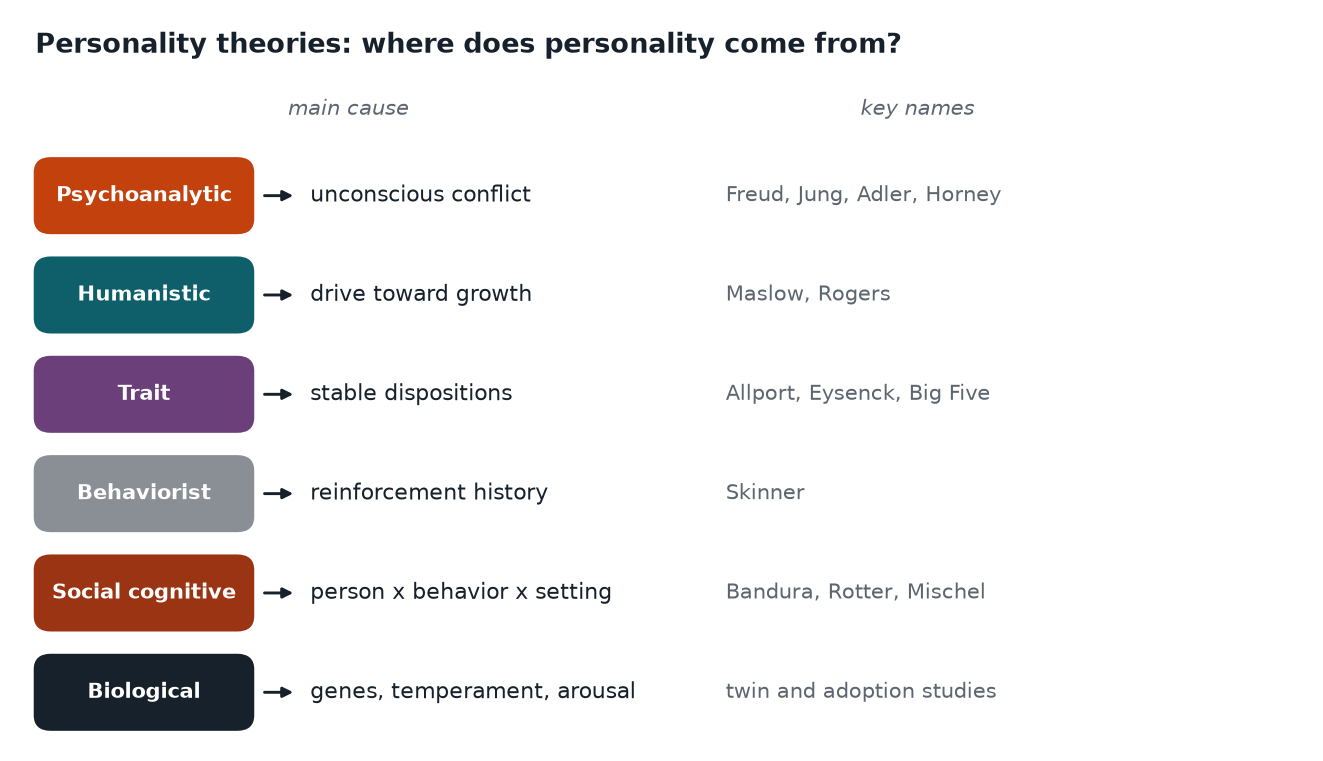
The six approaches at a glance
| Approach | Main cause of personality | Key names | Signature ideas |
|---|---|---|---|
| Psychoanalytic | Unconscious drives and early conflict | Freud; Jung, Adler, Horney | id, ego, superego; defense mechanisms; psychosexual stages |
| Humanistic | Conscious striving toward growth | Maslow, Rogers | self-actualization; unconditional positive regard; congruence |
| Trait | Stable, measurable dispositions | Allport, Eysenck, Costa and McCrae | Big Five; cardinal, central, secondary traits |
| Behaviorist | Reinforcement and punishment history | Skinner | personality as learned response patterns |
| Social cognitive | Person, behavior and environment shaping each other | Bandura, Rotter, Mischel | reciprocal determinism; self-efficacy; locus of control |
| Biological | Genes, temperament and brain systems | Eysenck (arousal), twin researchers | heritability; temperament; arousal levels |
Psychoanalytic: the mind in conflict
Freud described three parts of the psyche. The id wants immediate gratification and runs on the pleasure principle. The superego holds internalized rules and ideals and produces guilt. The ego follows the reality principle and negotiates between the two and the outside world. When that negotiation produces anxiety, the ego uses defense mechanisms that distort reality without the person noticing: repression, projection, displacement, reaction formation, sublimation, rationalization and regression are the ones tested most.
Freud tied adult personality to how children moved through the psychosexual stages (oral, anal, phallic, latency, genital). Getting stuck, called fixation, was said to leave traces such as an orderly, rigid style after a conflicted anal stage.
The neo-Freudians kept the unconscious but turned down the emphasis on sex. Jung added a collective unconscious of shared archetypes. Adler stressed striving for superiority and the inferiority complex. Horney argued that basic anxiety comes from insecure relationships and criticized Freud's account of women. Erikson replaced psychosexual stages with psychosocial stages that run across the lifespan.
Humanistic: the self that wants to grow
Humanistic theorists reacted against the idea that people are pushed around by hidden drives. They emphasized free will, conscious experience and a built-in tendency toward growth. Maslow placed self-actualization at the top of his hierarchy of needs, reachable once more basic needs are met. Rogers focused on the self-concept. If a person's real self and ideal self match, they are congruent and well adjusted; a large gap produces distress. Rogers believed congruence grows when others offer unconditional positive regard, acceptance that does not depend on meeting conditions of worth.
Trait: describing what is stable
Trait theory describes and measures personality more than it explains it. Allport sorted traits into cardinal (one trait that dominates a whole life, which is rare), central (the handful that describe someone well) and secondary (situation-bound preferences). Eysenck reduced personality to a few dimensions: extraversion, neuroticism and later psychoticism. The best-supported modern model is the Big Five: openness, conscientiousness, extraversion, agreeableness and neuroticism. Trait scores are fairly stable in adulthood, though they shift gradually with age.
Behaviorist and social cognitive: learning and context
Skinner's behaviorism treats personality as a set of behaviors shaped by consequences, so a "shy" person is someone whose social approaches were not reinforced. There is no need to infer inner states.
Social cognitive theory keeps learning but puts thought back in. Bandura's reciprocal determinism says that personal factors (beliefs, expectations), behavior and the environment all influence each other. His concept of self-efficacy, belief in your ability to succeed at a specific task, predicts effort and persistence. Rotter's locus of control separates people who credit outcomes to their own actions (internal) from those who credit luck or others (external). Mischel showed that behavior depends heavily on the situation, which pushed trait theorists to look at person by situation interactions.
Biological: what the body brings
The biological approach links personality to heredity and physiology. Twin and adoption studies find that many traits are moderately heritable, meaning genetic differences explain part of the variation among people in a population. Infants differ in temperament, such as activity level and reaction to novelty, from very early on. Eysenck proposed that introverts have a higher baseline cortical arousal, so they seek less stimulation than extraverts.
Worked example: classify the vignette
A student fails her first chemistry exam. Here is how each approach would explain her next move:
- She studies harder because she believes effort will pay off: social cognitive (self-efficacy, internal locus of control).
- She claims the exam was unfair and the course is pointless anyway: psychoanalytic (rationalization, a defense mechanism).
- She was always organized and dutiful, so she makes a study schedule: trait (high conscientiousness).
- Her advisor accepts her fully regardless of the grade, and she feels free to try new methods: humanistic (unconditional positive regard).
- She studies because past studying was followed by good grades: behaviorist (reinforcement history).
Common traps
- Self-efficacy vs self-esteem. Self-efficacy is task-specific belief in capability; self-esteem is overall sense of worth.
- Locus of control is Rotter, not Bandura. Both belong to the social cognitive family, but the terms are not interchangeable.
- Humanistic is not "optimistic psychoanalytic." Humanists stress conscious choice, not unconscious drives.
- Trait theory describes, it does not explain development. If a passage asks why a trait formed, trait theory alone is a weak answer.
- Heritable does not mean fixed. Heritability describes variation in a group, not how much of one person's trait is genetic.
One-minute recap
- Find the cause the passage stresses: unconscious conflict, growth, stable traits, reinforcement, person by situation loops, or biology.
- Freud: id, ego, superego and defenses. Neo-Freudians: Jung, Adler, Horney, Erikson.
- Maslow and Rogers: self-actualization, congruence, unconditional positive regard.
- Big Five: openness, conscientiousness, extraversion, agreeableness, neuroticism.
- Bandura: reciprocal determinism and self-efficacy. Rotter: locus of control.
The 7A Individual Behavior pack adds flashcards and practice questions on personality, motivation, and the biological bases of behavior. You can also try the free sampler first.
Check yourself: 5-question mini-quiz
1. A man who resents his boss comes home and yells at his dog. Which defense mechanism is this?
Displacement, shifting an impulse from a threatening target (the boss) to a safer one (the dog).
2. Which theorist proposed reciprocal determinism?
Albert Bandura, who held that personal factors, behavior and environment all influence one another.
3. According to Rogers, what condition helps a person become congruent?
Unconditional positive regard, acceptance that does not depend on meeting conditions of worth.
4. In Allport's scheme, what is a cardinal trait?
A single trait that dominates and organizes nearly all of a person's behavior; Allport considered it rare.
5. A patient believes her health depends mostly on luck and her doctors. Which construct describes this?
An external locus of control, a concept from Rotter's social cognitive work.