Free MCAT study note
Types of Memory for the MCAT: Sensory, Short-Term, Working, Long-Term
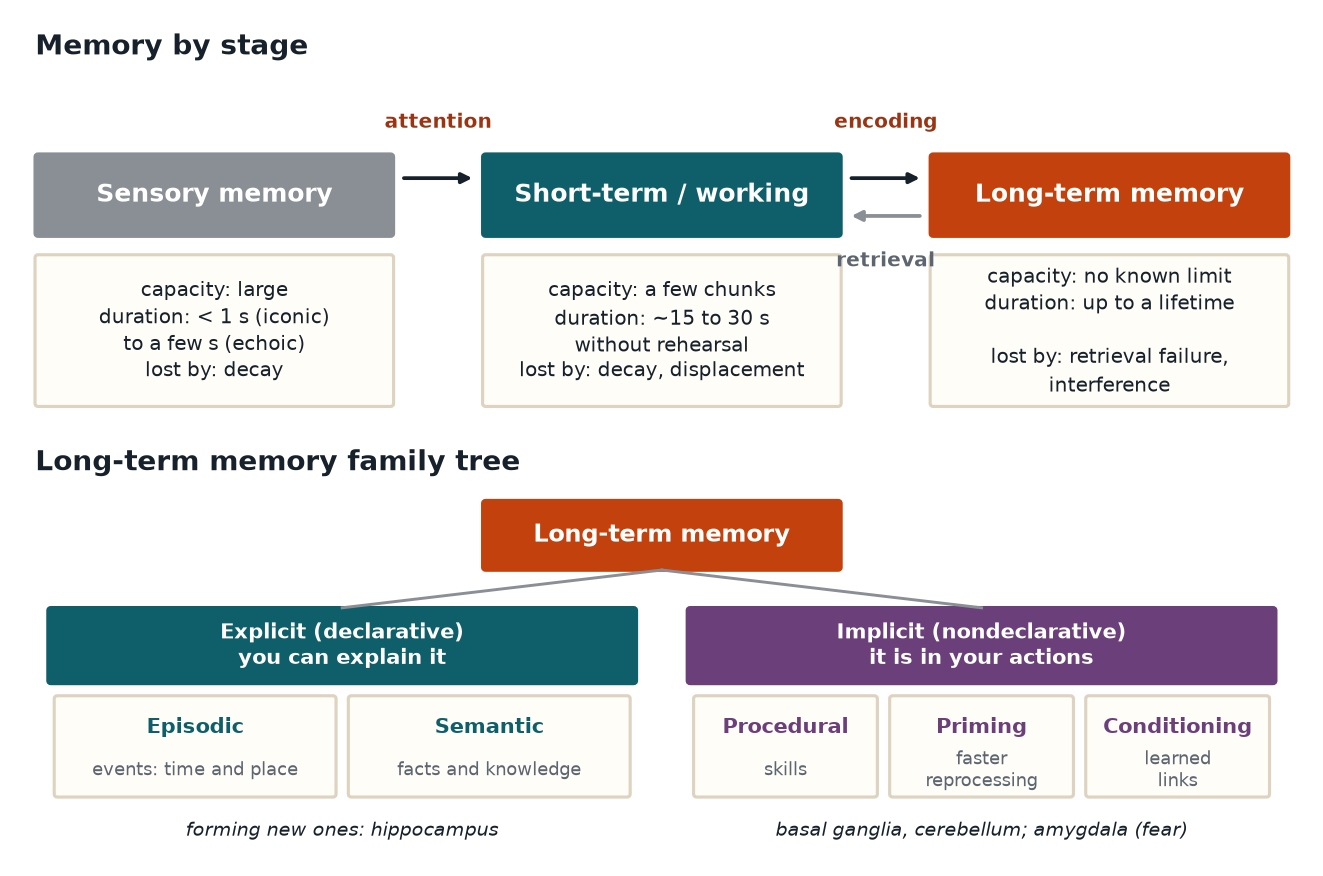
Memory is usually sorted two ways. By time, information passes from sensory memory (a fraction of a second to a few seconds) to short-term memory (roughly 15 to 30 seconds without rehearsal, a handful of items) and, if it is encoded well, into long-term memory (potentially a lifetime, with no known capacity limit). By content, long-term memory splits into explicit (declarative) memory that you can consciously report and implicit (nondeclarative) memory that shows up in performance. Working memory is the active workspace inside the short-term stage.
The three-stage model
The classic framework, proposed by Atkinson and Shiffrin in 1968, treats memory as a series of stores with a gate between each one.
- Sensory memory holds a raw, high-capacity copy of what the senses just picked up.
- Attention selects a small part of that copy and moves it into short-term memory.
- Encoding, especially rehearsal and elaboration, moves information from short-term into long-term memory.
- Retrieval brings long-term memories back into short-term memory when you need them.
The model is a simplification. Real memory is not a set of boxes in the skull, and later research replaced the passive short-term store with the idea of working memory. It is still the most useful map for sorting MCAT questions, because each stage has a typical capacity, duration and way of losing information.
Sensory memory
Sensory memory is a brief trace of a stimulus after it ends. Each sense has its own register, and two get most of the attention:
- Iconic memory (vision) lasts well under a second, on the order of a few hundred milliseconds.
- Echoic memory (hearing) lasts longer, around a few seconds. That longer trace is why you can sometimes "replay" the last words someone said even though you were not listening.
Capacity is large: the trace briefly holds much more than you can report. The classic evidence is the partial-report method. When people see a grid of letters for a split second, they can report only a few letters in total. But if a tone right after the flash tells them which single row to report, they can report most of that row, whichever row is cued. So the whole grid must have been available for a moment; it simply faded faster than people could read it out. Information in sensory memory is lost mostly by decay and by being overwritten by the next input.
Short-term memory
Short-term memory holds what you are currently aware of. Two numbers define it:
- Duration: about 15 to 30 seconds if you are prevented from rehearsing. Repeating the information (maintenance rehearsal) keeps it active much longer.
- Capacity: George Miller's 1956 estimate was "seven, plus or minus two" items. Later work that controls for chunking puts the true limit lower, closer to about four meaningful chunks. Either figure can appear in study materials; what matters is that the capacity is small and is counted in chunks, not raw characters.
Chunking is grouping items into meaningful units. The letters D, N, A, R, N, A, A, T, P are nine items for someone who sees no pattern and three items (DNA, RNA, ATP) for a biology student. Information is lost from short-term memory through decay when rehearsal stops and through displacement or interference when new items push old ones out.
Working memory
In 1974 Baddeley and Hitch argued that short-term memory is not just a holding tank but an active system for manipulating information. Their working memory model has these parts:
| Component | Job | Example |
|---|---|---|
| Central executive | Directs attention and coordinates the other parts | Deciding which step of a problem to work on |
| Phonological loop | Holds speech-based and sound information | Repeating a phone number under your breath |
| Visuospatial sketchpad | Holds images and spatial layouts | Picturing the route from your room to the kitchen |
| Episodic buffer (added in 2000) | Links information across the other parts and long-term memory | Holding a short scene that combines words and images |
A practical consequence: two tasks that use the same component interfere more than two tasks that use different ones. Repeating a word aloud disrupts memory for a list of words (both use the phonological loop) much more than it disrupts memory for the position of shapes.
Long-term memory
Long-term memory has no known capacity limit and can last for decades. Retrieval failure, not running out of room, is the usual reason people cannot recall something.
Explicit (declarative) memory
Explicit memory is memory you can consciously bring to mind and describe. It has two subtypes:
- Episodic memory: personal events tied to a time and place. "I ate dinner at my aunt's house last Thursday."
- Semantic memory: general facts and knowledge, stripped of when you learned them. "Paris is the capital of France."
Implicit (nondeclarative) memory
Implicit memory changes behavior without conscious recollection:
- Procedural memory: skills and habits, such as typing or riding a bike.
- Priming: earlier exposure to a stimulus speeds or biases later processing of a related stimulus, even if you do not remember the first exposure.
- Classical conditioning: learned associations between stimuli, such as a racing heart at the sound of a dentist's drill. See classical vs operant conditioning.
A memory aid of our own: explicit memory is the kind you can explain; implicit memory is the kind that is in your actions.
Where these memories live
| Memory | Brain region most tied to it |
|---|---|
| Forming new explicit memories (consolidation) | Hippocampus and nearby medial temporal lobe |
| Working memory | Prefrontal cortex |
| Procedural memory | Basal ganglia and cerebellum |
| Emotional memory, especially fear | Amygdala |
| Long-term storage of explicit memories | Distributed across the cortex |
The best-known case is Henry Molaison (known for decades as H.M.), whose medial temporal lobes, including much of both hippocampi, were removed in 1953 to treat severe epilepsy. Afterward he could not form new explicit memories (anterograde amnesia), yet he steadily improved at a mirror-drawing task across days while having no memory of having practiced it. His case showed that explicit and implicit memory depend on different brain systems, and that the hippocampus is needed to form new explicit memories rather than to store all old ones.
Worked example: chunking and the savings method
Chunking. A student tries to remember the 12-digit sequence 1 9 4 5 1 9 6 9 2 0 0 1. Treated as single digits, that is 12 items, well over any short-term capacity estimate. Seen as three years (1945, 1969, 2001), it is 3 chunks, comfortably within the limit. The amount of information did not change; the number of units did.
Savings. Long-term memory can be measured even when recall fails. Suppose a student needs 20 practice trials to learn a list perfectly. A month later she recalls none of it, but relearning takes only 8 trials. The savings score is:
savings = (original trials − relearning trials) / original trials = (20 − 8) / 20 = 0.60, or 60%
So 60% of the original learning effort was retained even though free recall showed nothing. This method dates back to Hermann Ebbinghaus in the 1880s, and it shows that relearning is the most sensitive of the three retrieval measures (recall, recognition, relearning).
How information gets in: encoding
- Maintenance rehearsal (simple repetition) keeps information in short-term memory but is a weak way to build long-term memories.
- Elaborative rehearsal links new information to what you already know. It produces much stronger long-term memories.
- Levels of processing (Craik and Lockhart, 1972): deeper, meaning-based (semantic) processing leads to better memory than shallow processing of appearance (structural) or sound (phonemic).
- Self-reference effect: relating information to yourself is an especially deep form of encoding.
- Automatic vs effortful processing: some information, such as where and how often things happened, is encoded with little effort, while textbook facts require effortful processing.
The serial position effect ties the stores together
When people recall a list in any order, they remember the first few items (primacy effect) and the last few items (recency effect) better than the middle. Primacy is usually explained by long-term memory: early items get the most rehearsal. Recency is usually explained by short-term memory: the last items are still active. Supporting this, a short distracting delay before recall wipes out the recency effect but leaves primacy largely intact.
Common traps
- Mixing up working memory and long-term memory. Working memory is the small, active, temporary workspace. Long-term memory is the large, durable store.
- Calling procedural memory explicit. Knowing how to ride a bike is implicit, even if you can describe some steps.
- Reversing episodic and semantic. Episodic has a time and place ("my first day of college"). Semantic is a context-free fact ("college usually lasts four years").
- Thinking the hippocampus stores all memories. It is crucial for forming and consolidating new explicit memories. Older memories are stored across the cortex, which is why H.M. kept many memories from well before his surgery.
- Treating "7 plus or minus 2" as a hard law. It is a rough estimate, and it applies to chunks.
- Assuming the recency effect comes from long-term memory. It reflects short-term memory and disappears after a distracting delay.
One-minute recap
- Sensory memory: huge capacity, under a second for vision and a few seconds for sound, lost to decay.
- Short-term memory: about 15 to 30 seconds without rehearsal, a few chunks of capacity. Chunking stretches it.
- Working memory (Baddeley and Hitch): central executive, phonological loop, visuospatial sketchpad, episodic buffer.
- Long-term memory: explicit (episodic, semantic) vs implicit (procedural, priming, conditioning).
- Hippocampus forms new explicit memories; basal ganglia and cerebellum handle procedural memory; amygdala handles emotional memory.
- Deep, meaningful encoding beats repetition. Relearning (savings) is the most sensitive measure of retention.
Check yourself: 5-question mini-quiz
1. A person remembers how to tie their shoes but cannot recall when they learned. Which type of memory is shoe tying?
Implicit procedural memory. It shows up in performance without conscious recollection, and it depends mainly on the basal ganglia and cerebellum.
2. After hippocampal damage, a patient cannot remember meeting a new nurse yesterday but still remembers his childhood home. What does this pattern show?
Anterograde amnesia for explicit memory. The hippocampus is needed to form new explicit memories, while older memories are stored across the cortex.
3. A student needs 25 trials to learn a list, and 10 trials to relearn it two weeks later. What is the savings score?
(25 − 10) / 25 = 0.60, or 60%. Savings shows retained learning even when free recall fails.
4. Saying "the, the, the" aloud while memorizing a list of words hurts recall. Which working memory component is overloaded?
The phonological loop, which holds speech-based information. Both the repeated word and the word list compete for it.
5. In a free-recall task, a 30-second distracting delay before recall removes which serial position effect, and why?
The recency effect. The last items were held only in short-term memory, which the delay and distraction clear, while primacy items had reached long-term memory.