Free MCAT study note
CARS Question Types Explained: What Each Stem Asks You to Do
Check your email
We sent a link to confirm your address. Nothing else is sent until you click it.
Download your free sample: 3-page Amino Acids, Proteins and Enzymes cheat sheet (PDF)
Meanwhile, start with the free notes.
CARS question types fall into three families: understanding what the passage says, reasoning about how its argument works, and carrying its ideas to new situations. Each family has its own stem wording and its own place to look for evidence. Naming the type before you read the choices tells you whether the answer sits in one sentence, in the shape of the whole argument, or outside the passage altogether.
The three families at a glance
| Family | What the stem asks | Where the evidence lives |
|---|---|---|
| Comprehension | What does the passage say or mean? | One or two sentences, or the passage as a whole for main idea |
| Reasoning within the text | How do the claims fit together? | The link between a claim and its support |
| Reasoning beyond the text | What follows if we apply or change something? | The author's principle, carried to a new case |
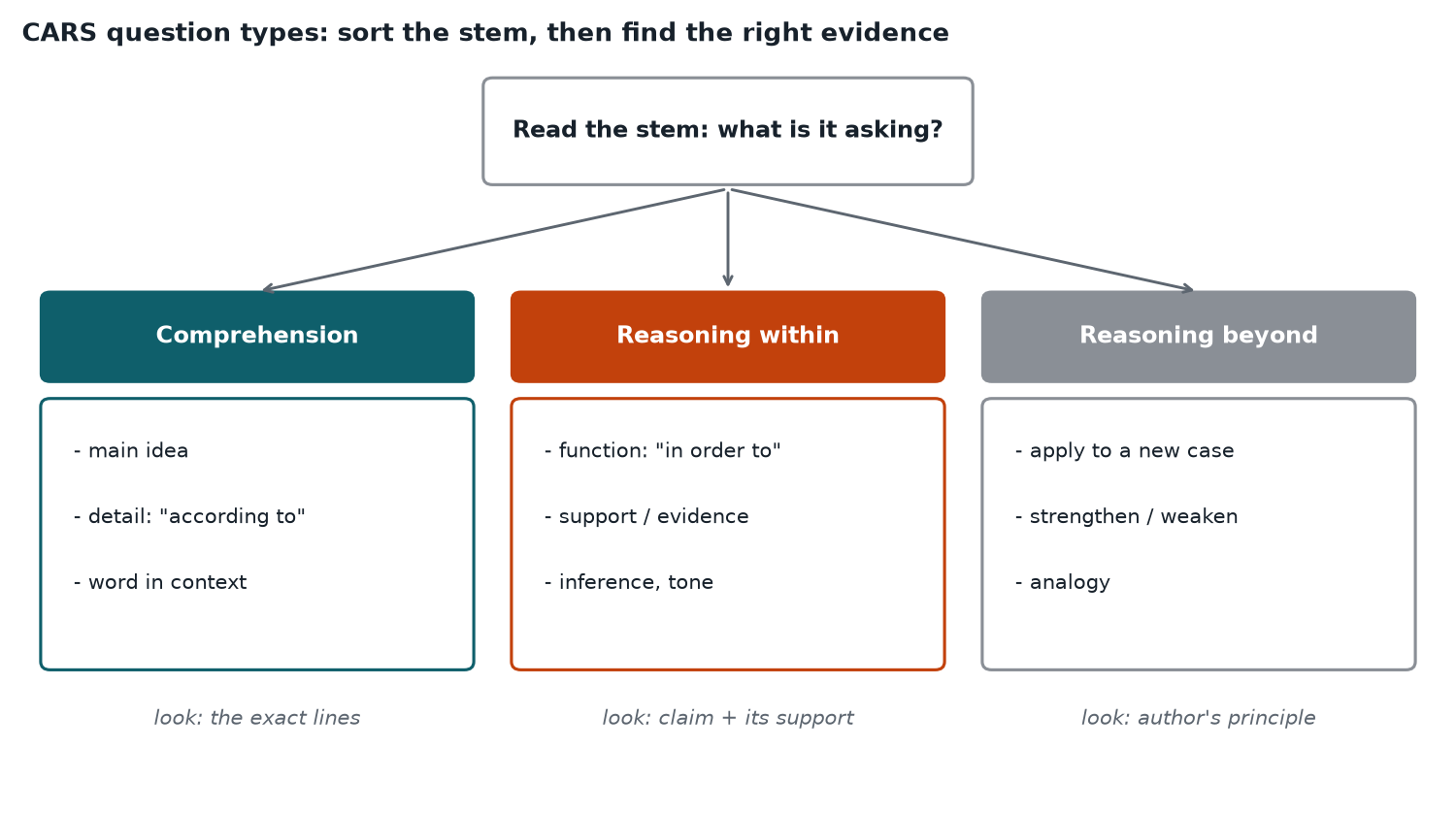
Family 1: comprehension
These questions test whether you followed the text. They are the most answerable from the passage alone, so they reward going back to the lines rather than trusting memory.
Main idea and purpose
Stems: "The central thesis of the passage is...", "The author's primary purpose is to...". The right answer covers the whole passage at the right strength. A choice that matches one paragraph only is too narrow; a choice that claims more than the author argued is too broad.
Detail and retrieval
Stems: "According to the passage...", "The author states that...". Find the sentence, then pick the choice that restates it in new words. Wrong choices often reuse the passage's exact vocabulary while changing the relationship, such as turning "some" into "most" or reversing a cause and effect.
Meaning in context
Stems: "As used in paragraph 3, the word 'discipline' most nearly means...". Read the sentence around the word and the one before it. The common dictionary meaning is frequently a trap, because the passage may use the word in a narrower or figurative sense.
Family 2: reasoning within the text
These questions are about the argument's structure. You need to know what each claim is doing, not just what it says.
Function and structure
Stems: "The author mentions the 1912 survey in order to...", "The reference to river engineers serves primarily to...". Ask what job the detail does: it may support a claim, illustrate it, concede a point to an opponent, or set up a contrast. Find the claim it serves; the answer names that relationship.
Support and evidence
Stems: "Which of the following claims is LEAST supported by evidence in the passage?", "The author's claim that X is supported by...". Sort the author's statements into those backed by an example, data or reasoning and those simply asserted. Opinions stated forcefully are not the same as supported claims.
Inference
Stems: "The passage implies that...", "The author would most likely agree that...". The correct choice must follow from what the author wrote, even though the author never says it in those words. The inference question guide goes deeper on this type.
Author's tone and attitude
Stems: "The author's attitude toward the reformers is best described as...". Collect the evaluative words the author uses about the subject, then match their strength. Authors in these passages are more often measured than extreme, so "qualified approval" beats "uncritical enthusiasm" unless the text is gushing.
Family 3: reasoning beyond the text
These stems bring in something new: a scenario, a finding, or an analogy. The passage gives you a principle; the question asks you to use it.
Application
Stems: "Which of the following situations best illustrates the author's idea of...?". State the author's principle in one plain sentence first, then test each scenario against it. The right scenario has the same structure even if the subject matter is completely different.
New information: strengthen or weaken
Stems: "Which finding, if true, would most challenge the author's claim that...?", "Suppose a historian discovered... How would this affect the argument?". Identify the exact claim under test and what it depends on. A weakening choice attacks that dependency directly. A choice can be true, relevant to the topic, and still have no bearing on the specific claim.
Analogy and extension
Stems: "The author's reasoning is most similar to which of the following?". Strip the passage argument down to its logic, such as "a tool built for one purpose ends up reshaping its users", and look for a choice with the same logic.
Worked example
Short original passage excerpt: "Public libraries once measured success by circulation, the number of books lent each year. Yet the busiest branches in the city now lend fewer books than a decade ago while their doors stay crowded, because residents come for internet access, tax help and quiet study space. Judging a library by its loans is like judging a hospital by its parking lot."
Three stems on this excerpt:
- "According to the passage, why do the busiest branches stay crowded?" This is a detail question. The answer restates the listed services: residents use internet access, tax help and study space.
- "The comparison to a hospital parking lot serves primarily to..." This is a function question. The comparison supports the claim that circulation is a poor measure of a library's value, by pairing it with an obviously irrelevant measure.
- "Which new finding would most weaken the author's argument?" This is a new information question. The argument depends on visitors coming for non-lending services, so a finding that most visitors in crowded branches were there only to borrow and return books would undercut it. A finding that library budgets fell would be on topic but would not touch that dependency.
Common traps
- Answering the type you expected, not the one asked. A function stem answered with a detail ("the survey found X") is wrong even if the detail is true. The question asked why the survey appears.
- Using outside knowledge on comprehension questions. If you know a fact about the topic but the passage does not say it, it cannot be the answer to "according to the passage".
- Confusing true with relevant. In strengthen or weaken questions, a correct statement about the topic may have no effect on the claim under test.
- Overreading tone. One sharp sentence does not make an author hostile. Weigh the evaluative words across the whole passage.
- Stopping at a partial match. In application questions, a scenario that shares the topic but not the structure is a trap.
The CARS Strategy pack adds flashcards on these question types and the wrong answer patterns that go with them, and you can try a free sampler first.
One-minute recap
- Sort every stem into one of three families before reading the choices.
- Comprehension questions live in specific lines, so go back to the text.
- Reasoning within the text is about what a claim does, not just what it says.
- Reasoning beyond the text applies the author's principle to something new; state the principle first.
- In strengthen or weaken questions, attack the dependency of the exact claim, not the topic.
Check yourself: 5-question mini-quiz
1. "The author refers to the 1912 survey in order to..." belongs to which question type?
Function or structure. The stem asks what job the detail does in the argument, not what the survey found.
2. Where should you look to answer an "according to the passage" question?
The specific sentence that states the point. Detail questions reward going back to the text and matching the meaning, not the vocabulary.
3. A choice for a weaken question is a true statement about the passage topic. Is that enough to make it correct?
No. It must undercut what the specific claim depends on; true but irrelevant choices are a common trap.
4. What is the first step for an application question?
Restate the author's principle in one plain sentence, then test each scenario for the same structure.
5. Why is "uncritical enthusiasm" often wrong in a tone question?
Authors usually take measured positions, so an extreme description rarely fits unless the evaluative words throughout the passage are equally strong.
Free MCAT sampler
Free sample: a 3-page MCAT cheat sheet (PDF), plus 6 short high-yield lessons by email
Enter your email and download a real page set from a paid pack: the 3-page Amino Acids, Proteins and Enzymes cheat sheet (PDF). Confirm your email and short MCAT lessons follow. Free, no card.
Prefer not to sign up? The sampler is open to everyone: free notes, practice sets and the study schedule generator.
Check your email
We sent a link to confirm your address. Nothing else is sent until you click it.
Download your free sample: 3-page Amino Acids, Proteins and Enzymes cheat sheet (PDF)
Meanwhile, start with the free notes.
Keep studying
- CARS Inference Questions: "The Author's Assertions Imply That...
- How to Approach a CARS Passage: A Step-by-Step Method
- Hard MCAT Questions: How to Review Them and Keep an Error Log
- CARS Anki Deck: Does One Exist, and What to Use Instead
- Why Freezing Point Depression Is a Colligative Property
- All free notes
Check your email
We sent a link to confirm your address. Nothing else is sent until you click it.
Download your free sample: 3-page Amino Acids, Proteins and Enzymes cheat sheet (PDF)
Meanwhile, start with the free notes.