Free MCAT study note
Classical vs Operant Conditioning: Differences, Terms and Examples
Classical conditioning pairs two stimuli, so that a neutral cue comes to trigger an automatic, involuntary response. Operant conditioning pairs a behavior with its consequence, so that a voluntary behavior becomes more or less frequent. A fast test: if the learner's response is a reflex the stimulus pulls out of them (salivating, flinching, feeling nauseated), it is classical. If the learner acts and the world responds with a reward or penalty, it is operant.
The one-line difference
| Classical conditioning | Operant conditioning | |
|---|---|---|
| What gets linked | Stimulus with stimulus | Behavior with consequence |
| Type of response | Involuntary, elicited by a stimulus | Voluntary, emitted by the learner |
| Timing that matters | Cue comes just before the stimulus | Consequence comes just after the behavior |
| Key figures | Ivan Pavlov, John Watson | Edward Thorndike, B.F. Skinner |
| Typical lab setup | Tone followed by food, measure salivation | Lever press followed by food, measure press rate |
Both are forms of associative learning, and both show acquisition, extinction, generalization and discrimination. Real life often mixes them, which is why passage questions sometimes describe both in one scenario.
Classical conditioning: the vocabulary
Pavlov noticed that dogs started to salivate before food arrived, at cues that predicted feeding. The terms come in a before and after pair:
- Unconditioned stimulus (US): triggers a response with no learning needed. Food in the mouth.
- Unconditioned response (UR): the natural reaction to the US. Salivation to food.
- Neutral stimulus (NS): produces no relevant response at first. A tone.
- Conditioned stimulus (CS): the former neutral stimulus, after pairing with the US.
- Conditioned response (CR): the learned response to the CS. Salivation to the tone.
The UR and CR are usually the same kind of behavior. What differs is the trigger. Ask "is this response happening because of something learned?" If yes, it is the CR.
A worked labeling example: a child gets a painful vaccine shot (pain makes her cry) in a room that smells of hand sanitizer. A few visits later, the smell alone makes her tense and tearful.
| Term | In this example |
|---|---|
| US | The painful shot |
| UR | Crying and distress at the pain |
| NS, then CS | The sanitizer smell |
| CR | Distress at the smell alone |
Classical conditioning processes
- Acquisition: the CS-US link forms over repeated pairings. It works best when the CS comes shortly before the US and predicts it (delay conditioning). Presenting the US first and the cue after (backward conditioning) produces little learning.
- Extinction: presenting the CS repeatedly without the US weakens the CR. Extinction is new learning that suppresses the old link, not erasure.
- Spontaneous recovery: after a rest period, an extinguished CR reappears, usually weaker. This is the evidence that extinction did not delete the original learning.
- Generalization: stimuli similar to the CS also trigger the CR. The child above may tense up at any hospital-like smell.
- Discrimination: learning to respond to the CS but not to similar stimuli that were never paired with the US.
- Taste aversion: a special case studied by John Garcia. One pairing of a flavor with later nausea can produce a strong aversion, even with hours between them. Animals learn taste-illness links much more easily than light-illness or sound-illness links, an example of biological preparedness.
Operant conditioning: the four cells
Thorndike's law of effect says behaviors followed by satisfying outcomes become more likely and behaviors followed by unpleasant outcomes become less likely. Skinner built a vocabulary on two yes or no questions:
- Is a stimulus added (positive) or removed (negative)?
- Does the behavior become more likely (reinforcement) or less likely (punishment)?
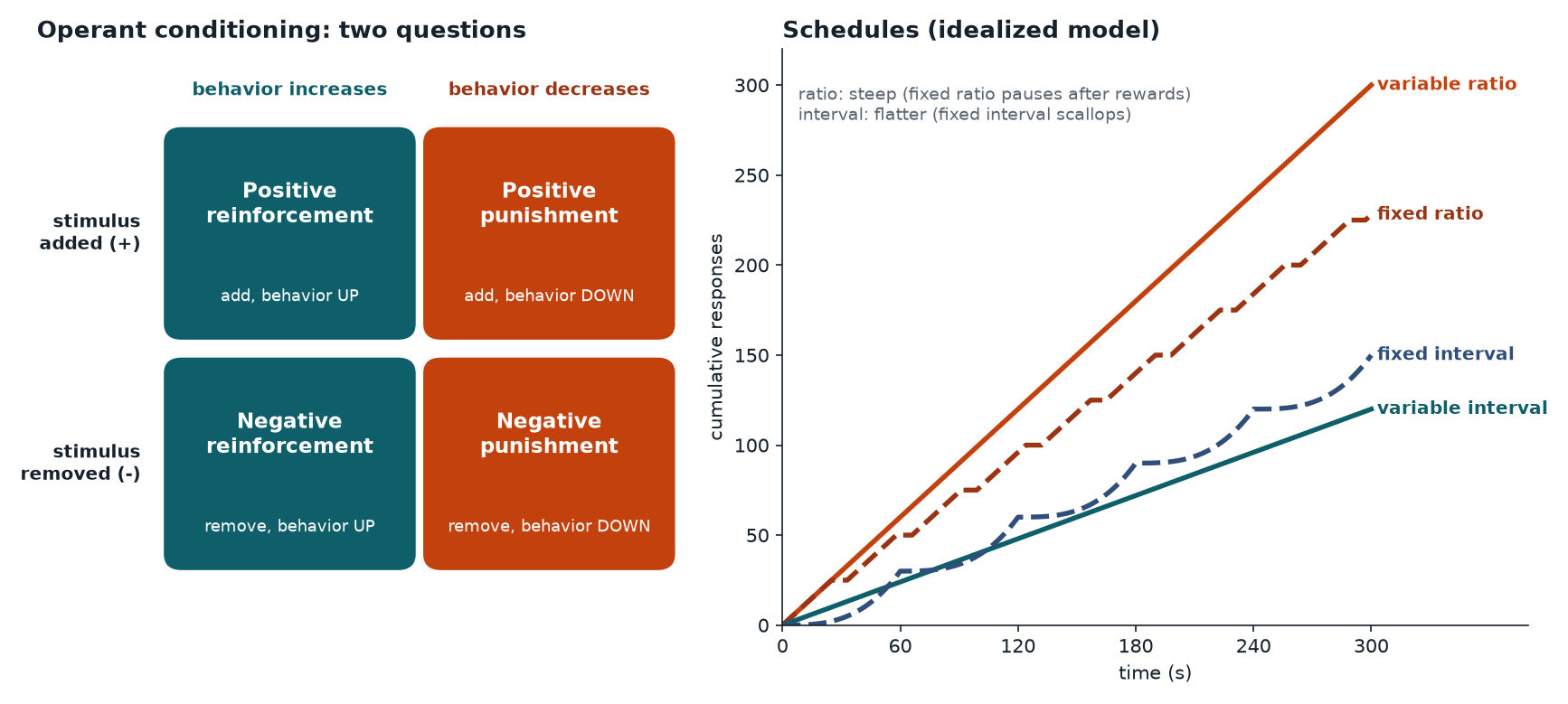
| Behavior increases | Behavior decreases | |
|---|---|---|
| Stimulus added (+) | Positive reinforcement: a bonus for finishing a shift early | Positive punishment: a fine for parking in a fire lane |
| Stimulus removed (−) | Negative reinforcement: closing a window shuts out jackhammer noise, so window closing increases | Negative punishment: a teen loses car privileges after missing curfew |
"Positive" and "negative" are math signs, not moral judgments. Negative reinforcement is not punishment: it always makes a behavior more likely by taking away something unpleasant.
Two common forms of negative reinforcement:
- Escape learning: the behavior ends an unpleasant stimulus that is already happening. Leaving a loud party once the headache starts.
- Avoidance learning: the behavior prevents the unpleasant stimulus from starting. Leaving before the music gets loud.
Shaping
Complex behaviors rarely appear on their own, so trainers reinforce successive approximations: first any movement toward a target, then only closer moves, then only the full behavior. A physical therapist rewarding a patient first for standing, then for one step, then for walking across the room is shaping.
Reinforcement schedules
Reinforcing every response (continuous reinforcement) produces the fastest learning, but the behavior also extinguishes quickly once rewards stop. Partial (intermittent) schedules learn more slowly but resist extinction. There are four:
| Schedule | Reward after | Example | Typical pattern |
|---|---|---|---|
| Fixed ratio (FR) | A set number of responses | A free coffee after every 10 purchases | High rate, brief pause after each reward |
| Variable ratio (VR) | An unpredictable number of responses, around an average | A salesperson whose cold calls pay off after an unpredictable number of tries | Highest, steadiest rate; most resistant to extinction |
| Fixed interval (FI) | The first response after a set time | Checking the oven near the end of a 20-minute bake | Responding speeds up as the time nears ("scalloping") |
| Variable interval (VI) | The first response after an unpredictable time | Checking for a reply to a text | Slow, steady rate |
A way to remember it: ratio schedules reward work, so more responding pays more. Interval schedules reward waiting, so extra responding before the time is up earns nothing. Variable schedules are harder to extinguish because the learner cannot easily tell when rewards have stopped.
Worked example: counting reinforcers
A rat presses a lever steadily for 10 minutes, 6 presses per minute, so 60 presses in total.
- FR-5 schedule: one food pellet per 5 presses. 60 / 5 = 12 pellets. If the rat doubled its rate to 120 presses, it would get 24 pellets. Payoff scales with effort.
- FI-60 s schedule: the first press after each 60-second interval earns a pellet. In 10 minutes there are 10 intervals, so the maximum is 10 pellets, whether the rat presses 60 or 600 times. Extra presses earn nothing, which is why FI schedules produce bursts of pressing near the end of each interval.
- VR-5 schedule: pellets come after an unpredictable number of presses averaging 5. Over 60 presses the expected total is about 12 pellets, the same average as FR-5, but no single press can be ruled out as the winner, which keeps responding high and steady.
The diagram's right panel plots this idea with an idealized model: ratio schedules climb faster because each extra response brings the next reward closer.
Beyond simple conditioning
- Latent learning: Edward Tolman's rats explored a maze without reward and made many errors, then improved sharply within a day or two of food being introduced. They had learned a cognitive map without reinforcement, which challenges a purely behaviorist view.
- Instinctive drift: trained animals sometimes slide back toward instinctive behaviors that compete with the trained response, another biological limit on conditioning.
- Observational learning: people also learn by watching others (Albert Bandura's Bobo doll studies), with no direct conditioning of the observer.
Common traps
- Calling negative reinforcement punishment. Reinforcement, positive or negative, always increases a behavior.
- Labeling a voluntary behavior as a CR. If the learner chooses the action to get or avoid an outcome, it is operant.
- Mixing up the UR and the CR. Same behavior, different trigger. The UR follows the US; the CR follows the CS.
- Thinking extinction erases learning. Spontaneous recovery shows the original association survives.
- Picking fixed ratio as most extinction-resistant. Variable ratio wins.
- Confusing punishment with extinction. Punishment adds or removes a stimulus after the behavior; extinction removes the reinforcement (or the US) that kept the response going.
One-minute recap
- Classical: stimulus-stimulus link, involuntary response, cue before US. Terms: US, UR, NS, CS, CR.
- Operant: behavior-consequence link, voluntary behavior, consequence after behavior.
- Positive means add, negative means remove. Reinforcement increases, punishment decreases.
- Escape and avoidance are negative reinforcement. Shaping rewards successive approximations.
- Continuous reinforcement: fast learning, fast extinction. Variable ratio: highest rate, slowest extinction. Fixed interval: scalloped responding.
- Extinction is suppression, shown by spontaneous recovery. Taste aversions show biological preparedness.
Check yourself: 5-question mini-quiz
1. A dog flinches at the sound of a can opener because the sound used to come right before a loud blender ran. What is the conditioned stimulus?
The can opener sound. It was neutral until paired with the blender noise (the US), and now it triggers flinching (the CR) on its own.
2. A student starts studying earlier in the week because doing so stops her parents' nagging. Which operant process is this?
Negative reinforcement. An unpleasant stimulus (nagging) is removed, and the studying behavior becomes more likely.
3. Which reinforcement schedule produces the highest response rate and the greatest resistance to extinction?
Variable ratio. Rewards depend on responding, and because the number of responses needed is unpredictable, it is hard to tell when rewards have stopped.
4. On an FI-30 s schedule, a pigeon pecks 300 times in 5 minutes. What is the maximum number of reinforcers it can earn?
- Five minutes holds ten 30-second intervals, and only the first peck after each interval is reinforced, regardless of how many pecks occur.
5. After a conditioned fear of a tone is extinguished, the fear briefly returns when the tone is played the next day. What is this called and what does it show?
Spontaneous recovery. It shows extinction suppressed the conditioned response rather than erasing the original association.