Free MCAT study note
DSM-5 Categories of Psychological Disorders for the MCAT
The DSM-5 (2013) and its 2022 text revision, the DSM-5-TR, are the American Psychiatric Association's manual for diagnosing psychological disorders. They sort roughly 20 diagnostic chapters by shared symptoms, and each diagnosis is a checklist of criteria: which symptoms, how many, for how long, and with how much distress or impairment. For test questions, three things decide most items: the chapter a disorder belongs to, the feature that separates it from its nearest look-alike, and the minimum duration.
What counts as a disorder
A behavior is not a disorder just because it is unusual. Clinicians weigh four features, often remembered as the four Ds:
- Deviance: the behavior departs from the norms of the person's culture.
- Distress: it causes the person real suffering.
- Dysfunction: it interferes with work, school, relationships or self-care.
- Danger: it puts the person or others at risk.
None of the four is enough alone. A gifted chess player deviates from the norm without any disorder, and grief after a death is distressing but expected. Diagnosis needs a pattern that matches criteria and impairs functioning.
The biopsychosocial model frames causes: biological factors (genes, neurotransmitters, brain structure), psychological factors (thought patterns, learning history) and social factors (poverty, trauma, support) all contribute, and they interact. A purely medical model, which looks only for a physical cause, is the older view the biopsychosocial model replaced.
Labels carry weight. In Rosenhan's 1973 study, healthy people admitted to psychiatric hospitals after reporting a single symptom had their later normal behavior read through the diagnosis. Whatever its methodological critics say, the study is cited as a warning about labeling and stigma.
What changed in DSM-5
A handful of structural changes come up repeatedly:
- The multiaxial system was dropped. DSM-IV rated people on five axes. DSM-5 simply lists diagnoses and lets clinicians rate severity and symptom dimensions where useful.
- Bipolar disorders got their own chapter, separate from depressive disorders.
- OCD and trauma disorders moved out of the anxiety chapter. Obsessive-compulsive and related disorders and trauma- and stressor-related disorders are now separate chapters.
- Autism spectrum disorder absorbed several earlier diagnoses, including Asperger's disorder, into one spectrum.
- The 2022 DSM-5-TR introduced prolonged grief disorder, for intense grief that persists well beyond cultural norms after a death.
The DSM is not the only system. The World Health Organization publishes the ICD, now in its 11th edition, which is used worldwide for health statistics and billing.
The major categories and how to tell neighbors apart
| Category | Core examples | The feature that separates it |
|---|---|---|
| Neurodevelopmental | ADHD, autism spectrum, Tourette | Onset in childhood; ADHD symptoms before age 12 in two or more settings |
| Schizophrenia spectrum | Schizophrenia, schizophreniform, brief psychotic, delusional, schizoaffective | Psychosis; the type is set mostly by duration and by whether a mood episode is present |
| Bipolar and related | Bipolar I, bipolar II, cyclothymic | Elevated mood episodes; bipolar I needs full mania |
| Depressive | Major depressive, persistent depressive, DMDD | Low mood or anhedonia with no history of mania or hypomania |
| Anxiety | GAD, panic, phobias, social anxiety, agoraphobia | Fear or worry with avoidance |
| Obsessive-compulsive and related | OCD, body dysmorphic, hoarding, trichotillomania | Repetitive thoughts or behaviors |
| Trauma- and stressor-related | PTSD, acute stress disorder, adjustment disorder | Requires an identifiable traumatic or stressful event |
| Dissociative | Dissociative identity, dissociative amnesia, depersonalization | Disrupted memory, identity or sense of self |
| Somatic symptom and related | Somatic symptom, illness anxiety, conversion, factitious | Focus on bodily symptoms or illness |
| Neurocognitive | Delirium, major neurocognitive disorder (dementia) | Acquired decline in cognition |
| Personality | Clusters A, B and C | Enduring, inflexible patterns since early adulthood |
Mood: depressive vs bipolar
Major depressive disorder needs at least five of nine symptoms for at least two weeks, and one of them must be depressed mood or loss of interest (anhedonia). Persistent depressive disorder is a milder but chronic low mood lasting at least two years in adults. Once a person has had even one manic or hypomanic episode, the diagnosis moves to the bipolar chapter.
Bipolar I requires a manic episode lasting at least a week (or any length if hospitalization is needed). Depression is common but not required. Bipolar II requires at least one hypomanic episode (four days or more, without marked impairment or psychosis) plus at least one major depressive episode. Cyclothymic disorder covers at least two years of ups and downs that never reach full criteria for either pole.
Psychosis: three disorders separated by time
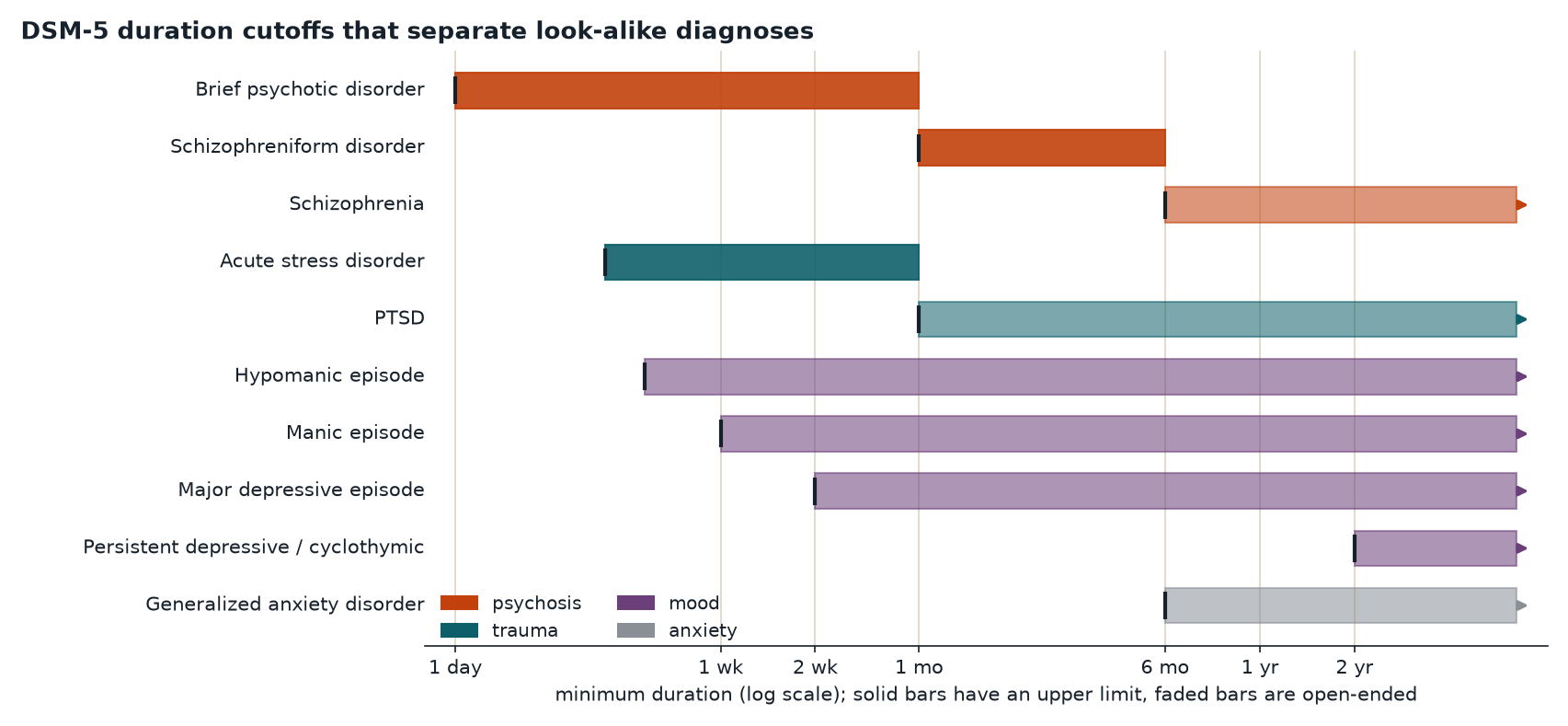
Schizophrenia needs two or more core symptoms (delusions, hallucinations, disorganized speech, grossly disorganized or catatonic behavior, negative symptoms) for a significant portion of one month, and at least one must be delusions, hallucinations or disorganized speech. Continuous signs must last six months, counting milder prodromal and residual periods. If the same picture lasts one to six months, it is schizophreniform disorder. If it lasts at least a day but less than a month with full return to function, it is brief psychotic disorder.
Positive symptoms add something that should not be there (hallucinations, delusions). Negative symptoms take away normal function (flat affect, avolition, alogia).
Anxiety, obsessions and trauma
Generalized anxiety disorder is excessive, hard-to-control worry about many things on more days than not for at least six months. Panic disorder means panic attacks that come out of the blue more than once, plus a month or longer of dreading the next one or changing behavior to avoid it. One panic attack is not panic disorder. In OCD, unwanted intrusive thoughts (obsessions) drive repetitive acts or mental rituals (compulsions) that briefly relieve the anxiety, and the person usually recognizes the thoughts as unwanted (ego-dystonic).
PTSD requires exposure to trauma, then four symptom clusters (intrusion, avoidance, negative changes in thought and mood, and changes in arousal and reactivity) lasting more than one month. The same reaction lasting three days to one month is acute stress disorder.
Somatic symptom disorders: watch the motive
Somatic symptom disorder is excessive worry about real, distressing symptoms. Illness anxiety disorder is preoccupation with having a serious illness when symptoms are absent or mild. Conversion disorder (functional neurological symptom disorder) involves neurological symptoms, such as weakness or seizure-like episodes, that do not fit a known disease. Factitious disorder is faking or inducing illness to occupy the sick role. Faking illness for an external payoff such as money or avoiding work is malingering, which is not classified as a mental disorder.
Personality disorders: three clusters
Personality disorders are long-lasting patterns of inner experience and behavior that deviate from cultural expectations and cause impairment. They are usually ego-syntonic: the person sees the traits as part of who they are.
- Cluster A (odd, eccentric): paranoid, schizoid, schizotypal.
- Cluster B (dramatic, erratic): antisocial, borderline, histrionic, narcissistic.
- Cluster C (anxious, fearful): avoidant, dependent, obsessive-compulsive.
Antisocial personality disorder cannot be diagnosed before age 18 and requires evidence of conduct disorder before age 15.
Worked example: diagnose by the clock
Many questions give a short vignette and a timeline. Convert everything to the same unit, then compare with the cutoffs in the figure.
Case 1. A 24-year-old has heard voices and believed his phone is monitored by a government agency for 10 weeks. He has no mood episode. Ten weeks is 70 days, roughly 2.3 months. That is more than one month and less than six, so the diagnosis is schizophreniform disorder. If the same symptoms continue past 26 weeks (about six months), it becomes schizophrenia.
Case 2. A woman survived a house fire 19 days ago and has nightmares, avoids the street, and startles at sirens. Nineteen days falls between 3 and 30 days, so the diagnosis is acute stress disorder, not PTSD. At day 31 with the same symptoms, PTSD becomes the better fit.
Case 3. A man had 5 days of elevated mood, little need for sleep and rapid speech, without hospitalization or psychosis, and a major depressive episode last year. Five days meets the four-day hypomania threshold but not the seven-day mania threshold, so this fits bipolar II. Had the elevated mood lasted 8 days with marked impairment, it would be mania and bipolar I.
Biological and psychological explanations at a glance
- Depression: the monoamine hypothesis (low serotonin, norepinephrine and dopamine signaling), HPA-axis overactivity; Beck's cognitive triad and learned helplessness as psychological accounts.
- Schizophrenia: excess dopamine activity in the mesolimbic pathway is linked to positive symptoms; reduced mesocortical activity to negative symptoms. Enlarged ventricles are a common finding.
- Anxiety: amygdala hyperreactivity; Mowrer's two-factor theory says fears are acquired by classical conditioning and maintained because avoidance is negatively reinforced (see classical vs operant conditioning).
- Neurocognitive: Alzheimer disease shows amyloid plaques, tau tangles and loss of acetylcholine neurons, and it erodes the memory systems described in types of memory.
Common traps
- Bipolar II is not "milder bipolar." It has hypomania but never full mania, and it requires a major depressive episode. Depression in bipolar II can be severe.
- One panic attack is not panic disorder. Panic disorder needs recurrent, unexpected attacks plus a month of worry or behavior change.
- OCD vs obsessive-compulsive personality disorder. OCD has true obsessions and compulsions and is usually ego-dystonic. OCPD is a rigid, perfectionistic personality style that is ego-syntonic.
- Factitious vs malingering. Same faking, different motive: the sick role vs an external reward.
- Delirium vs dementia. Delirium has an acute, fluctuating course and is often reversible. Dementia develops gradually.
- Psychosis vs insanity. Psychosis is a clinical description of lost contact with reality. Insanity belongs to courts, not clinics.
- OCD and PTSD are not anxiety disorders in DSM-5. They have their own chapters.
One-minute recap
- Four Ds: deviance, distress, dysfunction, danger. Diagnosis needs the criteria plus distress or impairment.
- DSM-5 dropped the multiaxial system, split bipolar from depressive disorders, and moved OCD and trauma out of anxiety. DSM-5-TR's newest diagnosis: prolonged grief disorder.
- Psychosis by duration: under 1 month brief psychotic, 1 to 6 months schizophreniform, 6 months or more schizophrenia.
- Trauma reactions: acute stress disorder from day 3 to day 30, PTSD once symptoms pass a month.
- Mood: hypomania 4 days, mania 7 days, major depressive episode 2 weeks, persistent depressive and cyclothymic 2 years.
- Personality clusters: A odd, B dramatic, C anxious. Usually ego-syntonic.
Check yourself: 5-question mini-quiz
1. A patient has had hallucinations and disorganized speech for three months with no mood episode. What is the most likely diagnosis?
Schizophreniform disorder. Psychotic symptoms lasting between one and six months fit schizophreniform; six months or more would be schizophrenia.
2. A person has had one hypomanic episode and two major depressive episodes, but never mania. Which disorder fits?
Bipolar II disorder. It requires at least one hypomanic episode and one major depressive episode with no history of full mania.
3. Someone fakes chest pain in the emergency room only to obtain opioids. Is this factitious disorder?
No, it is malingering. Faking for an external reward is malingering, while factitious disorder involves faking illness to occupy the sick role.
4. Which DSM-5 change removed the five-axis rating of each patient?
DSM-5 dropped the multiaxial system. In its place is one flat list of diagnoses, with severity and dimensional ratings added where useful.
5. Into which personality disorder cluster does avoidant personality disorder fall?
Cluster C, the anxious and fearful cluster, along with dependent and obsessive-compulsive personality disorders.