Free MCAT study note
Erikson's 8 Stages of Psychosocial Development Explained
Erik Erikson proposed that personality develops through eight psychosocial stages that span the entire lifespan, from infancy to old age. Each stage centers on a crisis, a tension between a healthy outcome and an unhealthy one, such as trust vs mistrust in infancy or identity vs role confusion in adolescence. Resolving a crisis well gives the person a lasting strength Erikson called a virtue. To answer most questions, match the person's age and main social challenge to the stage, then name the crisis or virtue.
The core ideas
- Psychosocial, not psychosexual. Erikson trained in Freud's tradition but shifted the focus from body zones and libido to relationships and social demands: caregivers, schools, peers, partners, work and community.
- Lifespan. Freud's stages end with the genital stage at puberty. Erikson added three adult stages, so development never finishes.
- Crisis as a turning point. "Crisis" means a period of heightened vulnerability and potential, not a disaster. Every stage has two poles, and a healthy outcome leans toward the positive pole while keeping a little of the negative. Some mistrust, for example, is realistic and protective.
- Not settled for good. A crisis that went poorly can be revisited and reworked later, and earlier strengths can be shaken by later events.
- Sequence matters. Erikson held that each stage builds on the ones before it. His best-known example: a secure identity has to come before true intimacy, because you need a self before you can share it.
The eight stages
Ages are approximate and vary somewhat between sources. The ranges below are the ones used throughout this note.
| # | Approximate age | Crisis | Virtue | The question in plain words | Typical arena |
|---|---|---|---|---|---|
| 1 | Birth to 1.5 years | Trust vs mistrust | Hope | Will my needs be met? | Feeding and comfort |
| 2 | 1.5 to 3 years | Autonomy vs shame and doubt | Will | Am I allowed to do it myself? | Toilet training, dressing, walking |
| 3 | 3 to 6 years | Initiative vs guilt | Purpose | Can I start things without feeling wrong for wanting to? | Play and exploration |
| 4 | 6 to 12 years | Industry vs inferiority | Competence | Am I good at things others value? | School, sports, hobbies |
| 5 | 12 to 18 years | Identity vs role confusion | Fidelity | Who am I, and where do I fit? | Peer groups, values, career ideas |
| 6 | 18 to 40 years | Intimacy vs isolation | Love | Can I share my life with someone? | Partners and close friendships |
| 7 | 40 to 65 years | Generativity vs stagnation | Care | Am I contributing to people who will outlast me? | Parenting, mentoring, work |
| 8 | 65 years and up | Integrity vs despair | Wisdom | Can I accept the life I have lived? | Looking back over one's life |
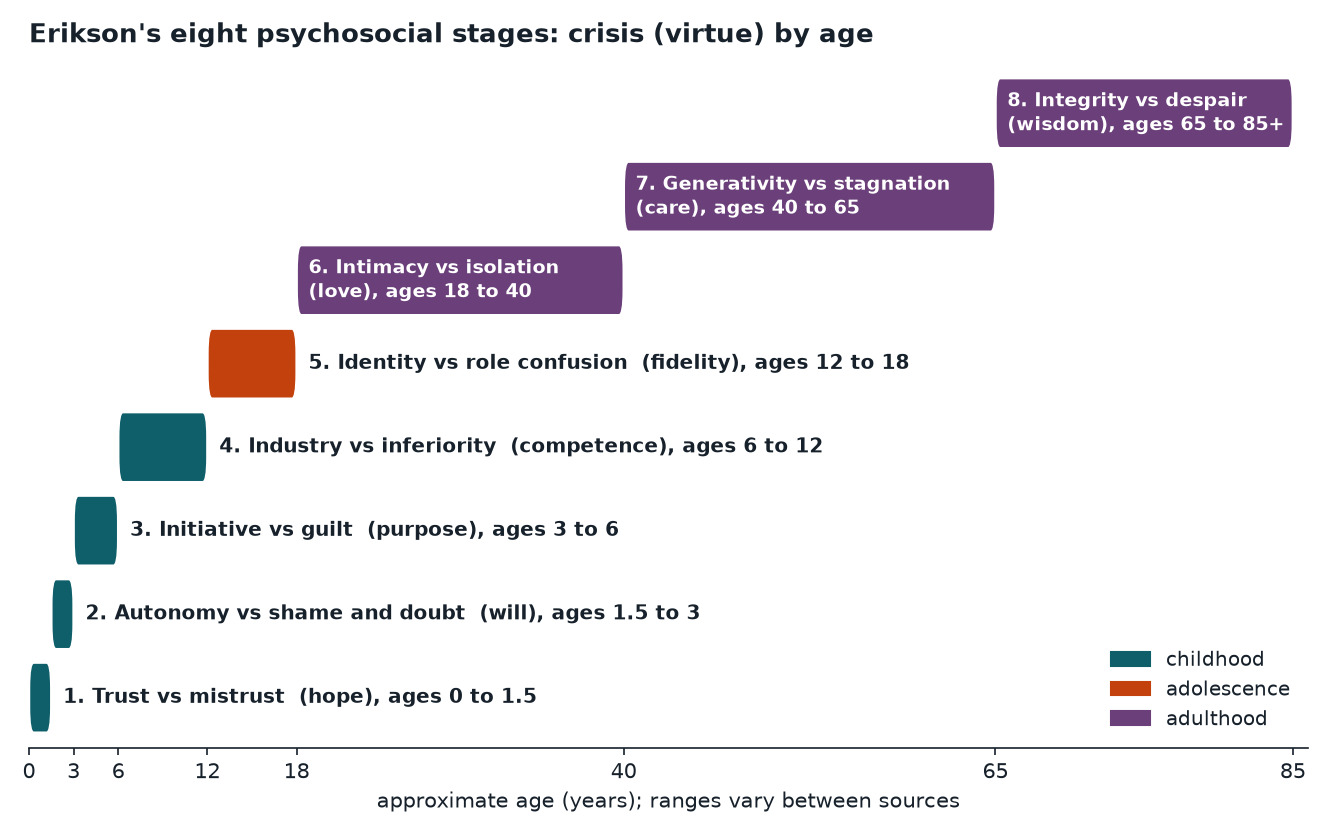
Stage by stage
1. Trust vs mistrust. An infant whose needs are met consistently learns that the world is predictable and people can be relied on. Neglect or erratic care breeds mistrust. The virtue is hope.
2. Autonomy vs shame and doubt. Toddlers want to walk, feed themselves, choose clothes and use the toilet. Room to try, with safe limits, builds will. Overcontrol or harsh criticism of accidents breeds shame and self-doubt.
3. Initiative vs guilt. Preschoolers plan games, ask endless questions and take on make-believe roles. Encouragement builds purpose. Being punished or mocked for taking initiative leaves guilt about wanting things.
4. Industry vs inferiority. School-age children compare their skills with peers' in reading, sports, music and crafts. Success and recognition build competence. Repeated failure or constant comparison leaves a sense of inferiority.
5. Identity vs role confusion. Adolescents try out values, friend groups, careers and beliefs to build a coherent sense of self. The virtue is fidelity, the ability to stay loyal to chosen commitments. Without that integration, the person drifts between roles. James Marcia later turned this stage into four identity statuses based on exploration and commitment: diffusion (neither), foreclosure (commitment without exploration), moratorium (exploration without commitment yet) and achievement (both).
6. Intimacy vs isolation. Young adults face the task of forming deep, committed relationships, romantic or not, without losing themselves. Success brings love. Fear of losing one's identity in a relationship can lead to isolation.
7. Generativity vs stagnation. Middle-aged adults look for ways to contribute to the next generation: raising children, mentoring, creative work, community service. The virtue is care. Stagnation is self-absorption and a sense that one's life is not adding anything.
8. Integrity vs despair. Older adults look back over their lives. Accepting the life lived, mistakes included, brings integrity and wisdom. Bitterness over missed chances and fear of death signal despair. Robert Butler's idea of the life review describes this reflective process.
Worked example: match the vignette to the stage
Use a two-step check: first the age, then the social challenge described. When they agree, the answer is solid. When they disagree, the challenge usually wins, because the crisis is the content of the stage.
Vignette A. A 2-year-old insists on putting on his own shoes and screams when his father does it for him. Age 2 falls in the 1.5 to 3 range, and the challenge is independence. Stage 2, autonomy vs shame and doubt.
Vignette B. A 9-year-old quits piano after deciding she is "the worst" in her class. Age 9 falls in 6 to 12, and the challenge is skill compared with peers. Stage 4, industry vs inferiority, leaning toward inferiority.
Vignette C. A 52-year-old engineer starts volunteering to train new hires because he wants the next generation to do better than he did. Age 52 falls in 40 to 65, and the challenge is contributing to others. Stage 7, generativity vs stagnation, resolving toward generativity.
Vignette D. A 30-year-old has spent her 20s switching majors, cities and belief systems and feels she cannot commit to her partner because she does not know who she is yet. Age points to stage 6, but the described struggle is identity. Erikson's sequencing explains this: an unresolved identity crisis (stage 5) is getting in the way of intimacy (stage 6). A question asking which earlier crisis was left unresolved wants identity vs role confusion.
Counting check. How many of the eight stages fall entirely before age 18? Stages 1 through 5, which is 5 of 8, or 62.5 percent. Three stages, a minority, cover the remaining several decades of life, which shows how much weight Erikson still placed on childhood despite extending the theory into adulthood.
Erikson vs Freud
| Feature | Freud (psychosexual) | Erikson (psychosocial) |
|---|---|---|
| Driving force | Libido focused on body zones | Social relationships and demands |
| Number of stages | Five | Eight |
| Ends at | Genital stage, beginning at puberty | Old age |
| Outcome of a problem stage | Fixation | Unhealthy pole, which can be revisited later |
| Testability | Hard to test | Also hard to test, but more descriptive of social life |
The early stages line up roughly with Freud's: trust vs mistrust with the oral stage, autonomy vs shame with the anal stage, initiative vs guilt with the phallic stage, and industry vs inferiority with latency. The adult stages have no Freudian counterpart.
Criticisms worth knowing
- Vague, hard to measure. Terms such as "integrity" and "fidelity" are difficult to operationalize, so the theory is more descriptive than predictive.
- Fixed age ranges. Life paths vary. People may form an identity later, have children at 45, or revisit identity after a career change or divorce.
- Cultural assumptions. The sequence reflects mid-twentieth-century Western norms, such as the idea that a separate personal identity comes before commitment. Collectivistic cultures may frame identity in more relational terms.
Common traps
- Mixing up autonomy and initiative. Autonomy is the toddler doing things by herself (feeding, dressing). Initiative is the preschooler starting activities and plans (organizing a game).
- Placing identity vs role confusion in young adulthood. Identity is the adolescent stage. Intimacy is young adulthood.
- Calling generativity "having children." Parenting is one route. Mentoring, teaching, art and community work also count.
- Forgetting virtues. Questions sometimes give the virtue (hope, will, purpose, competence, fidelity, love, care, wisdom) and ask for the stage.
- Treating crises as one-time events. Erikson saw them as recurring themes that can be reworked.
- Confusing Erikson and Freud. Social and lifelong means Erikson; libido and body zones mean Freud.
One-minute recap
- Eight stages, birth to old age, each a crisis between two poles with a virtue as the healthy outcome.
- Infancy trust (hope), toddler autonomy (will), preschool initiative (purpose), school-age industry (competence).
- Adolescence identity (fidelity), young adulthood intimacy (love), middle age generativity (care), late life integrity (wisdom).
- Identity must precede intimacy. Marcia's four identity statuses expand stage 5.
- Erikson is psychosocial and lifelong; Freud is psychosexual and ends at puberty.
Check yourself: 5-question mini-quiz
1. A 4-year-old organizes a pretend restaurant with her friends but is scolded and told her ideas are silly. Which Erikson crisis is at stake?
Initiative vs guilt. Preschoolers who are discouraged from starting plans and activities may feel guilty about taking initiative.
2. Which virtue results from successfully resolving the generativity vs stagnation stage?
Care. Middle-aged adults who contribute to the next generation through parenting, mentoring or community work develop care.
3. According to Erikson, which crisis must be resolved before a person can achieve true intimacy?
Identity vs role confusion. Erikson held that a secure sense of self must come before a person can share it in a close relationship.
4. A 70-year-old reflects on her life and feels it was meaningful despite mistakes. Which stage and outcome does this describe?
Integrity vs despair, resolved toward integrity. Accepting one's life as lived gives the virtue of wisdom.
5. How does Erikson's theory differ from Freud's in the span of life it covers?
Erikson's stages continue through old age, while Freud's psychosexual stages end with the genital stage that begins at puberty.
Keep studying
- Conformity vs Obedience: Asch and Milgram Explained
- Role Strain vs Role Conflict, Status Types and Social Groups
- All free notes
Email list
Get new packs and free notes
Packs are for sale now. Join the list and we email you when a new pack or free note goes up.
Free right now: the free sampler of study notes and practice questions.
You are on the list.
We will email you when a new pack or free note goes up. Meanwhile, start with the free sampler notes.