Free MCAT study note
How Long to Study for the MCAT: Size Your Own Timeline
Free MCAT sampler
Get the free MCAT sampler + 6 short high-yield lessons by email
Confirm your email and we send the sampler link, then short MCAT lessons. Free, no card.
Prefer not to sign up? The sampler is open to everyone: free notes, practice sets and the study schedule generator.
Check your email
We sent a link to confirm your address. Nothing else is sent until you click it.
Meanwhile, start with the free notes.
There is no official answer. The AAMC, which writes the exam, does not publish a recommended number of weeks or hours; its prep page says only that "Preparing for the MCAT exam takes time and dedication" and points you toward two habits: make a study plan and practice regularly (AAMC: Prepare for the MCAT Exam). So the useful question is not "how long does everyone study?" but "how long do I need, given where I start?" This note shows how to answer that for yourself in four steps.
Why a borrowed number fails
Any single figure you read online was built around someone else's background. Two students with the same test date can need very different timelines: one finished biochemistry last semester and reads dense passages quickly, the other last saw physics years ago. A timeline copied from a forum ignores both facts. A timeline sized from your own data adapts to them.
The exam itself is broad. It has four multiple-choice sections (AAMC: About the MCAT Exam):
| Section | What it draws on |
|---|---|
| Biological and Biochemical Foundations of Living Systems | biology, biochemistry |
| Chemical and Physical Foundations of Biological Systems | general and organic chemistry, physics, biochemistry |
| Psychological, Social, and Biological Foundations of Behavior | psychology, sociology, biology |
| Critical Analysis and Reasoning Skills | passage reasoning, no outside content |
Breadth is exactly why your starting point matters more than any average: the gaps you carry into each section decide how long content review takes.
Step 1: take a diagnostic before you plan
Start with a timed practice test under realistic conditions, before you review anything. The goal is not a good score. The goal is a baseline you can measure progress against and a list of what went wrong.
Use official practice where you can. The AAMC offers some free MCAT Official Prep resources and sells low-cost products written by the test developers, with a comparison page listing them (AAMC prep page). If cost is a barrier, the AAMC Fee Assistance Program provides discounted fees and free Official Prep products, among other benefits.
Take it under real timing. The AAMC notes that the optional 10 or 30 minute breaks are fixed, and that time left over from a section you finish early, or a break you skip, does not carry over (AAMC: MCAT FAQs). Practicing with the same break rules tells you about stamina, not just knowledge.
Step 2: turn misses into a gap list
After the diagnostic, sort every missed or guessed question into one of three bins:
- Content gap: you did not know the fact or concept (for example, you forgot which way a buffer shifts).
- Reasoning gap: you knew the content but misread the passage, the graph, or the question stem.
- Timing gap: you would have got it right with more time, or you never reached it.
Then map the content gaps onto the AAMC content outline, the "What's on the MCAT Exam?" material that lists the concepts, content categories, skills, and disciplines tested. The outline turns a vague feeling ("I'm weak in chem") into a checklist of specific categories. Mark each category as solid, shaky, or new to you.
The ratio between the bins is the most important planning number you will produce. A list dominated by content gaps needs a longer review phase. A list dominated by reasoning and timing gaps needs more passage practice and full-length tests, and content review can be short.
Step 3: plan backward from the test date
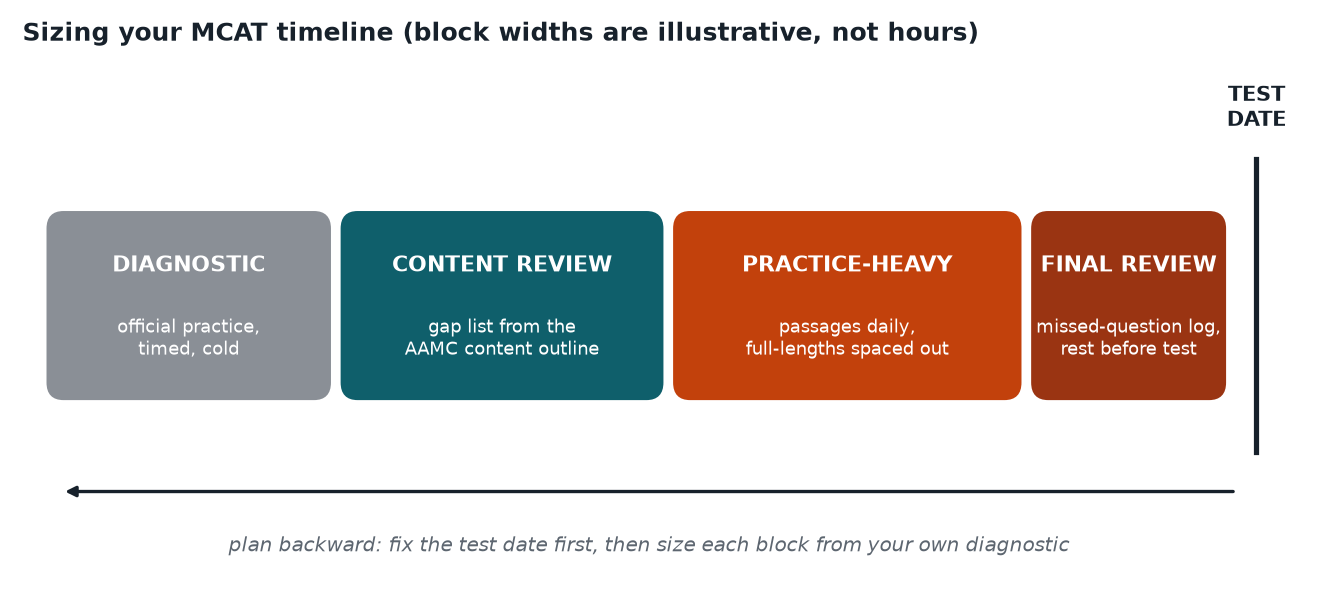
Fix the test date first, then work backward. Four blocks, sized by your gap list:
- Final review (closest to test day): go through your log of missed questions, redo the ones you still get wrong, and protect sleep. No new content.
- Practice-heavy phase: daily passage sets in every section, with full-length tests spaced far enough apart that you can review each one thoroughly before the next. A full-length you do not review teaches very little.
- Content review: work through the shaky and new categories from Step 2. Size this block by counting categories, not by copying someone else's calendar.
- Diagnostic: already done, at the very start.
Now check the fit. If the blocks do not fit before your date, you have three honest choices: cut lower-yield breadth, add daily study time, or move the date. Deciding this early beats discovering it in the last two weeks.
A worked example of sizing
Suppose your diagnostic review produces 40 misses: 28 content, 8 reasoning, 4 timing. That is 70% content gaps (28 out of 40), so content review deserves the biggest block. A second student with 10 content, 20 reasoning, and 10 timing misses has 25% content gaps and should start passage practice almost immediately. Same exam, different timelines, and neither needed a borrowed number.
Step 4: use the practice trend to adjust
Your plan is a forecast, so update it. Every time you take a full-length or a large passage set, ask:
- Is the share of content gaps shrinking? If not, review is not sticking; change how you review, not just how much.
- Are the same categories showing up again? Move them back into the content block.
- Is timing still costing points? Add timed sections rather than more reading.
Signals that you may need more time: your practice results are flat across several tests, or the same categories keep reappearing in your misses. Signals that the plan is working: misses are spreading out (no repeating category) and your review log is getting shorter. None of these signals promise a particular score; they tell you whether the plan is doing its job.
How spaced repetition shortens content review
Content review is the block most people overspend on, because rereading feels productive but fades quickly. Spaced repetition flips that: you answer a card from memory, and the scheduler shows it again just before you would forget it. Facts you already know get shown rarely, so your time goes to the shaky items from your gap list.
Practical rules:
- Make or pick cards for the shaky and new categories first, not the solid ones.
- Do reviews daily, even short sessions, during both the content and practice phases. Stopping reviews during practice lets content fade right before test day.
- When a practice question exposes a forgotten fact, add or unsuspend the card for it the same day.
Common traps
- Planning before the diagnostic. Without a baseline, every block is a guess.
- Counting hours instead of categories. Time spent is not the same as gaps closed.
- Saving all full-lengths for the end. You lose the feedback that should reshape the plan.
- Skipping review of practice tests. The review is where the learning happens.
- Ignoring CARS because it has no content. Reasoning gaps need regular practice too; see how to approach a CARS passage.
One-minute recap
The AAMC gives no fixed study duration, so size your own. Take a timed official diagnostic first. Sort misses into content, reasoning, and timing gaps, and map content gaps onto the AAMC content outline. Fix the test date and plan backward: content review, a practice-heavy phase with spaced full-lengths, then final review. Adjust from the practice trend, and use daily spaced repetition so reviewed content does not fade. To see what a scaled score means, try the MCAT percentile tool.
Check yourself: 5-question mini-quiz
1. Does the AAMC publish a recommended number of weeks to study for the MCAT?
No. Its prep page says preparation takes time and dedication and recommends a study plan and regular practice, but gives no fixed duration.
2. What should you do before writing a study plan?
Take a timed diagnostic practice test, so the plan is sized from your own baseline and misses rather than a borrowed number.
3. A diagnostic shows 28 content, 8 reasoning, and 4 timing misses. Which block should be largest?
Content review, since 28 of 40 misses (70%) are content gaps.
4. If you finish a section early on test day, does the leftover time carry over?
No. The AAMC states that time left from a section finished early, or a skipped break, does not carry over to the next section.
5. Why keep doing spaced repetition reviews during the practice-heavy phase?
Stopping reviews lets reviewed content fade right before test day; daily reviews keep it fresh while practice builds reasoning and timing.