Free MCAT study note
How to Use Anki for the MCAT: A Daily Routine That Holds Up
Free MCAT sampler
Get the free MCAT sampler + 6 short high-yield lessons by email
Confirm your email and we send the sampler link, then short MCAT lessons. Free, no card.
Prefer not to sign up? The sampler is open to everyone: free notes, practice sets and the study schedule generator.
Check your email
We sent a link to confirm your address. Nothing else is sent until you click it.
Meanwhile, start with the free notes.
To use Anki well for the MCAT, do your due reviews first every day, add only as many new cards as those reviews can absorb, and keep each card to one testable fact. Anki handles memorization: amino acids, hormones, equations, psych and soc terms. It does not teach you to reason through a passage, so it always runs alongside practice questions, never instead of them.
What Anki actually does
Anki is a free flashcard program built on spaced repetition. Each time you see a card, you grade how well you recalled it. Cards you know get pushed further into the future; cards you miss come back soon. Over weeks, the gaps between reviews stretch for material you know and stay short for material you do not.
That scheduling is the whole point. It means the program decides what you review today, and your job is to show up and answer honestly. Grading a card as easy when you hesitated pushes it away before it is solid, and that cost shows up weeks later.
Where flashcards fit on the MCAT
The exam has four sections: Biological and Biochemical Foundations of Living Systems; Chemical and Physical Foundations of Biological Systems; Psychological, Social, and Biological Foundations of Behavior; and Critical Analysis and Reasoning Skills (CARS). The AAMC overview of the exam explains that the three science sections ask you to combine content knowledge with scientific inquiry and reasoning skills.
That split tells you where Anki earns its time:
| Section | Good Anki material | What cards cannot do |
|---|---|---|
| Bio/Biochem | amino acid structures, enzyme classes, hormone sources and targets | interpret an experiment's figure |
| Chem/Phys | equations, units, constants you use often, functional groups | set up a multi-step calculation |
| Psych/Soc | theory names, definitions, classic studies | apply a term to a new scenario |
| CARS | almost nothing | all of it: this is reading and reasoning |
CARS has no science content to memorize, so do not build a CARS deck. Practice passages are the tool there. See how to approach a CARS passage.
A daily routine
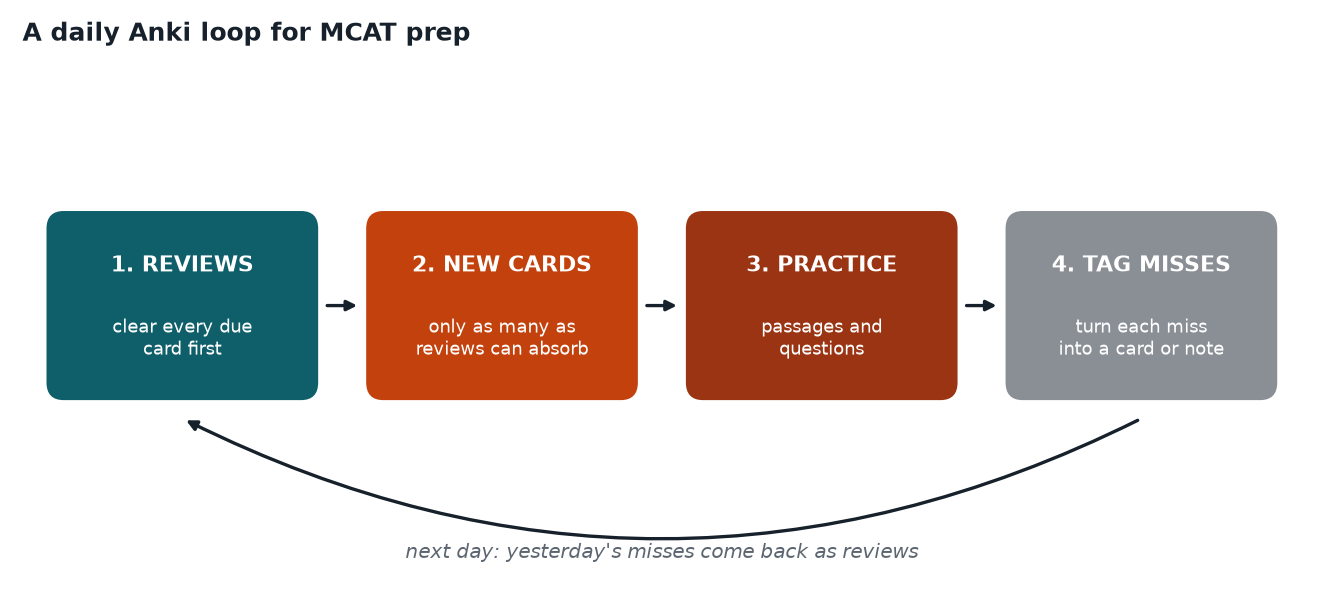
- Reviews first. Clear every due card before anything else. Reviews are the cards closest to being forgotten, so they give the most value per minute.
- New cards second. Add new cards only after reviews are done. Anki's default limit is 20 new cards per day; treat that as a ceiling to adjust, not a target.
- Practice third. Do passages or discrete questions in the content you studied. This is where knowledge turns into points.
- Tag misses last. For every missed practice question, ask whether a fact was missing. If yes, add or unsuspend a card for it. If the miss was about reasoning, write a short note instead.
The loop closes the next morning, when yesterday's misses show up as reviews.
Worked example: why new cards drive your workload
Every new card you add today becomes a stream of future reviews. Suppose you add 30 new cards a day for 10 days. That is 30 × 10 = 300 cards in rotation, and in the first weeks most of them come back often because their intervals are still short.
Now suppose you skip three days. The cards that came due on those days do not disappear; they stack up and all show on day four. If you also add another 30 new cards that day, the session balloons and the temptation is to rush or quit.
The fix is simple: when reviews start taking longer than you planned, cut new cards for a few days until the review count settles. Reviews are the work; new cards are optional.
Writing cards that work
Good cards are small. A card that asks for one fact is fast to answer and easy to grade honestly. A card that asks for a paragraph gets graded generously, and that defeats the scheduler.
- One fact per card. "Which amino acids are basic?" is fine as a cloze list. "Explain everything about the urea cycle" is not a card.
- Use cloze deletions for lists and sequences. Hide one item at a time so each item gets its own schedule.
- Prefer recall over recognition. Ask for the answer, not for a yes or no.
- Add images where shape matters. Structures, graphs, and pathway layouts are easier to recall from a picture.
- Write your own words. Copying a textbook sentence onto a card makes it easy to recognize and hard to produce.
If a card keeps failing, rewrite it. Repeated misses usually mean the card asks for too much or is vague.
Premade decks vs. your own cards
Premade decks save the hours it takes to type cards and usually cover the content outline evenly. The risk is volume: unsuspending everything on day one floods you with new cards.
A practical middle path:
- Start with a premade deck with everything suspended.
- Tag or filter by section and topic.
- Unsuspend a topic only after you have studied it from a text or video.
- Add your own cards for facts you missed in practice that the deck lacks.
Suspend cards you already know cold. Time spent on facts you will never forget is time not spent on facts you will.
Linking Anki to the rest of your plan
Anki is one part of a schedule, not the schedule. Content review tells you what to unsuspend, practice questions tell you what you actually missed, and full-length practice exams tell you whether it all holds up under time pressure. For sizing the whole plan, see how long to study for the MCAT.
Keep reviews going through your final weeks. Stopping Anki a month out lets the facts you built decay right when you need them.
Common traps
- Too many new cards. The most common reason people abandon Anki. Cap new cards and protect your review time.
- Reviewing without understanding. If you can recite a card but cannot explain it, go back to the source. Memorized words without meaning do not survive a passage.
- Grading too kindly. If you hesitated or guessed, mark it as missed.
- Skipping practice passages. A large review count feels productive, but the exam asks you to use facts inside passages.
- Making CARS cards. CARS rewards reading and reasoning practice, not memorized content.
- Long gaps. Missed days pile reviews onto later days. Short daily sessions beat occasional marathons.
One-minute recap
- Anki uses spaced repetition: cards you know come back less often, misses come back soon.
- Daily order: reviews, then new cards, then practice, then tag misses.
- New cards set your future workload; cut them when reviews pile up.
- One fact per card, cloze for lists, your own words, honest grading.
- Use Anki for the three science sections, not for CARS, and always alongside practice questions.
Check yourself: 5-question mini-quiz
1. What should you do first in each Anki session?
Clear your due reviews. They are the cards closest to being forgotten, so they give the most value per minute.
2. Your daily reviews have doubled after a busy week. What is the best adjustment?
Pause or cut new cards for a few days. New cards drive future reviews, so reducing them lets the backlog settle.
3. Why is a card that asks you to explain a whole pathway a poor card?
It is slow to answer and hard to grade honestly, so you tend to grade it generously and the scheduler loses accuracy. Split it into single facts.
4. Should you build a flashcard deck for CARS?
No. CARS tests reading and reasoning through passages with no science content to memorize, so practice passages are the right tool.
5. You missed a practice question because you forgot a hormone's target. What should you do?
Add or unsuspend a card for that fact, so the miss becomes a review that comes back on a schedule.