Free MCAT study note
Negative Reinforcement vs Punishment: How to Tell Them Apart
Check your email
We sent a link to confirm your address. Nothing else is sent until you click it.
Download your free sample: 3-page Amino Acids, Proteins and Enzymes cheat sheet (PDF)
Meanwhile, start with the free notes.
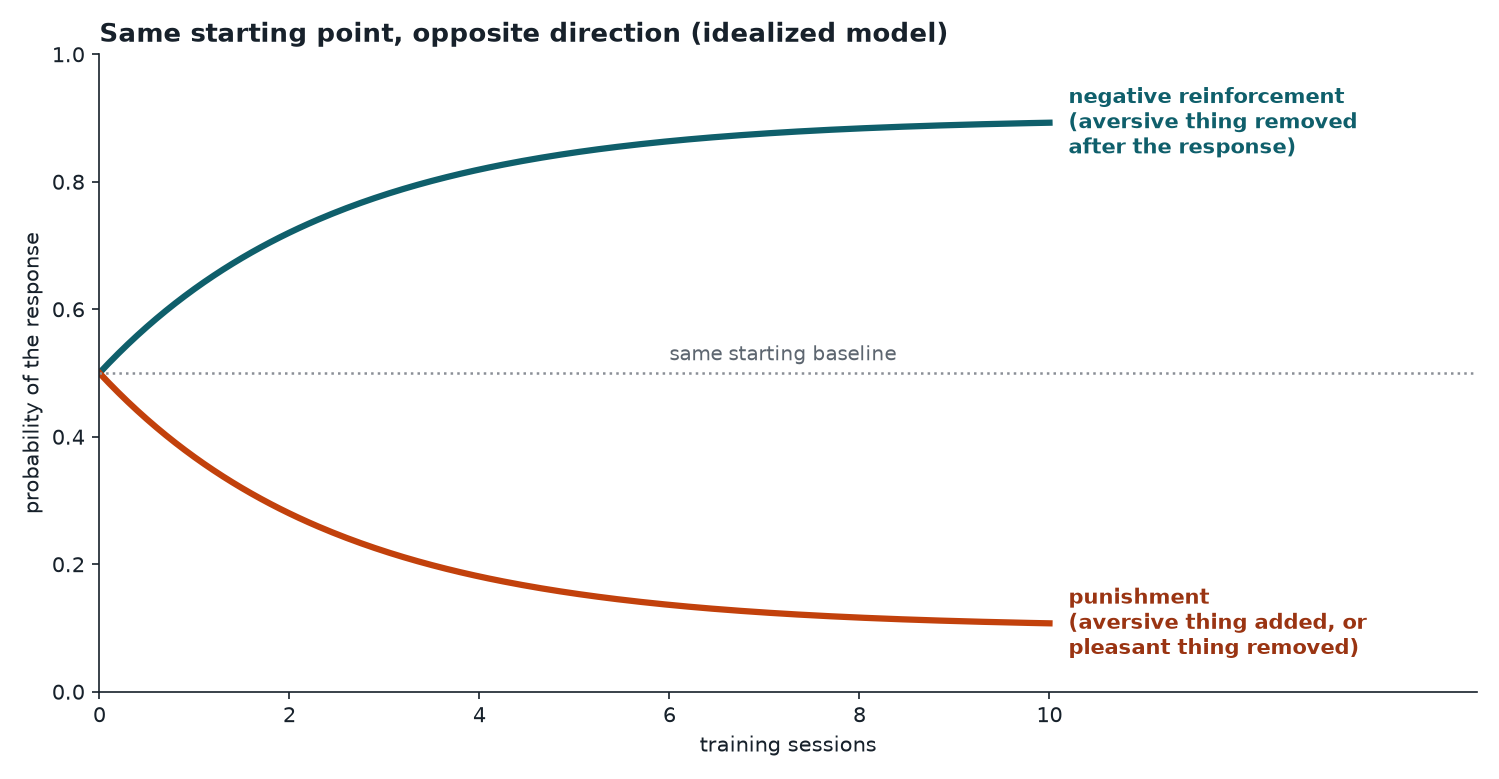
Negative reinforcement and punishment are opposites, not synonyms. Negative reinforcement makes a behavior more likely by taking away something unpleasant after the behavior happens. Punishment makes a behavior less likely, either by adding something unpleasant or by taking away something pleasant. If the behavior goes up, it is reinforcement, whatever the word "negative" makes you feel.
Why the names confuse people
In operant conditioning, the words "positive" and "negative" do not mean good and bad. They describe arithmetic: positive means a stimulus is added after the behavior, negative means a stimulus is removed. The words "reinforcement" and "punishment" describe the result: reinforcement raises the future rate of the behavior, punishment lowers it.
So "negative reinforcement" reads as "remove something, and the behavior increases." The thing removed is almost always aversive: noise, pain, nagging, a chore. Removing it feels like relief, and relief is what strengthens the behavior that produced it.
| Stimulus added | Stimulus removed | |
|---|---|---|
| Behavior increases | Positive reinforcement | Negative reinforcement |
| Behavior decreases | Positive punishment | Negative punishment |
Notice that negative reinforcement and positive punishment often involve the same kind of stimulus, something aversive. The difference is timing and direction. In negative reinforcement the aversive stimulus is already present and the behavior ends it. In positive punishment the aversive stimulus is absent and the behavior brings it on.
The two-question test
Classify any scenario with two questions, asked in this order.
- What happened to the behavior afterward? If it became more frequent, the answer is some form of reinforcement. If it became less frequent, it is some form of punishment. Answer this first, because it eliminates half the options at once.
- Was a stimulus added or removed right after the behavior? Added means positive, removed means negative.
The order matters. Students who start with "was it pleasant?" tend to label anything unpleasant as punishment, which is exactly the mistake the exam likes to test.
Escape and avoidance: two flavors of negative reinforcement
Negative reinforcement comes in two forms that are worth naming.
- Escape learning: the aversive stimulus is already happening, and the behavior ends it. A person with a pounding headache takes a pain reliever, the pain fades, and reaching for the pill bottle becomes more likely the next time a headache starts.
- Avoidance learning: the behavior prevents an aversive stimulus that has not arrived yet, often because a warning cue signals it. A driver who learned that a certain street floods after heavy rain starts taking a different route whenever the forecast calls for storms.
Avoidance is why some fears are so persistent. If a person always avoids the feared situation, they never experience it turning out fine, and each avoidance is rewarded with relief. This makes negative reinforcement a common explanation for how phobic avoidance is maintained.
Two kinds of punishment
Punishment also comes in two forms.
- Positive punishment adds an aversive consequence: a speeding ticket, a scolding, extra laps at practice.
- Negative punishment removes something the person values: losing phone privileges, a time-out from play, a fine that takes away money. Time-out and response cost are the classic labels here.
Punishment tends to suppress a behavior rather than teach a replacement. It works best when it is immediate and consistent, and it is often paired with reinforcement of an alternative behavior so the person learns what to do instead.
Worked example with numbers
Scenario 1. A teacher announces that any student who turns in every homework assignment on time for a week will be excused from the Friday pop quiz, which students dislike. Before the policy, 12 of 30 students submitted all homework on time, which is 12 / 30 = 40 percent. After three weeks, 24 of 30 do, which is 24 / 30 = 80 percent.
- Did the behavior change? On-time homework increased, so this is reinforcement.
- Was something added or removed? The quiz, an aversive event, was removed.
- Answer: negative reinforcement, specifically avoidance, because students act to prevent a quiz that has not happened yet.
Scenario 2. A library starts charging a fee for every overdue book. Late returns fall from 50 per month to 20 per month, a drop of (50 minus 20) / 50 = 60 percent.
- Did the behavior change? Late returns decreased, so this is punishment.
- Was something added or removed? Money is taken away, so this is negative punishment (response cost). If you view the fee as an added unpleasant event, you might be tempted to call it positive punishment; most courses classify fines as response cost because the person loses something they value.
The numbers matter only for the direction. Any increase points to reinforcement and any decrease points to punishment.
Common traps
- "Negative" does not mean "bad." A trap answer will label an unpleasant consequence as negative reinforcement when the behavior actually dropped. That is punishment.
- Check whose behavior you are classifying. When a parent gives a crying child candy and the crying stops, the child is positively reinforced for crying, while the parent is negatively reinforced for giving candy, because the crying (an aversive stimulus for the parent) ends.
- Relief is the signal for negative reinforcement. If the scenario describes a feeling of relief after a behavior, look for an aversive stimulus that was removed or avoided.
- Do not confuse extinction with negative punishment. Extinction stops delivering the reinforcer that used to follow the behavior. Negative punishment actively takes away a different valued thing as a consequence.
- Do not confuse negative reinforcement with classical conditioning. Operant terms describe consequences that follow a voluntary behavior. Classical conditioning pairs two stimuli before any response; see classical vs operant conditioning for that contrast.
The Learning and Behavior Change pack adds flashcards and practice questions on conditioning, reinforcement schedules and attitude change, and you can try the free sampler first.
One-minute recap
- Reinforcement increases a behavior; punishment decreases it.
- Positive means a stimulus is added; negative means a stimulus is removed.
- Negative reinforcement removes or prevents something aversive (escape and avoidance), so the behavior increases.
- Positive punishment adds something aversive; negative punishment removes something valued; both make the behavior decrease.
- Always ask about the behavior's direction first, then about adding or removing.
Check yourself: 5-question mini-quiz
1. A rat presses a lever that turns off a mild shock, and lever pressing increases. What is this?
Negative reinforcement, specifically escape learning, because an aversive stimulus is removed and the behavior increases.
2. A teenager who misses curfew loses access to the family car for a week, and late arrivals stop. What is this?
Negative punishment, because a valued privilege is taken away and the behavior decreases.
3. A worker who is yelled at for arriving late arrives late less often. What is this?
Positive punishment, because an aversive stimulus is added and the behavior decreases.
4. Which of the two classification questions should you answer first?
Whether the behavior increased or decreased, because that decides reinforcement versus punishment before you consider adding or removing.
5. A hiker carries sunscreen on every trip after one painful sunburn and never burns again. Which type of learning is this?
Avoidance learning, a form of negative reinforcement, because the behavior prevents an aversive outcome before it occurs.
Free MCAT sampler
Free sample: a 3-page MCAT cheat sheet (PDF), plus 6 short high-yield lessons by email
Enter your email and download a real page set from a paid pack: the 3-page Amino Acids, Proteins and Enzymes cheat sheet (PDF). Confirm your email and short MCAT lessons follow. Free, no card.
Prefer not to sign up? The sampler is open to everyone: free notes, practice sets and the study schedule generator.
Check your email
We sent a link to confirm your address. Nothing else is sent until you click it.
Download your free sample: 3-page Amino Acids, Proteins and Enzymes cheat sheet (PDF)
Meanwhile, start with the free notes.
Keep studying
- Classical vs Operant Conditioning: Differences, Terms and Examples
- Cognitive Dissonance and the Elaboration Likelihood Model for the MCAT
- Kohlberg's Stages of Moral Development, Explained for the MCAT
- Weber Fraction Formula and JND: Worked Examples
- Stress Response: General Adaptation Syndrome, Cortisol and Appraisal
- Self-Serving Bias vs Actor-Observer Bias: The Difference
- Schachter-Singer Two-Factor Theory vs Cannon-Bard: How to Tell Them Apart
- All free notes
Check your email
We sent a link to confirm your address. Nothing else is sent until you click it.
Download your free sample: 3-page Amino Acids, Proteins and Enzymes cheat sheet (PDF)
Meanwhile, start with the free notes.