Free MCAT study note
Piaget's Stages of Cognitive Development for the MCAT
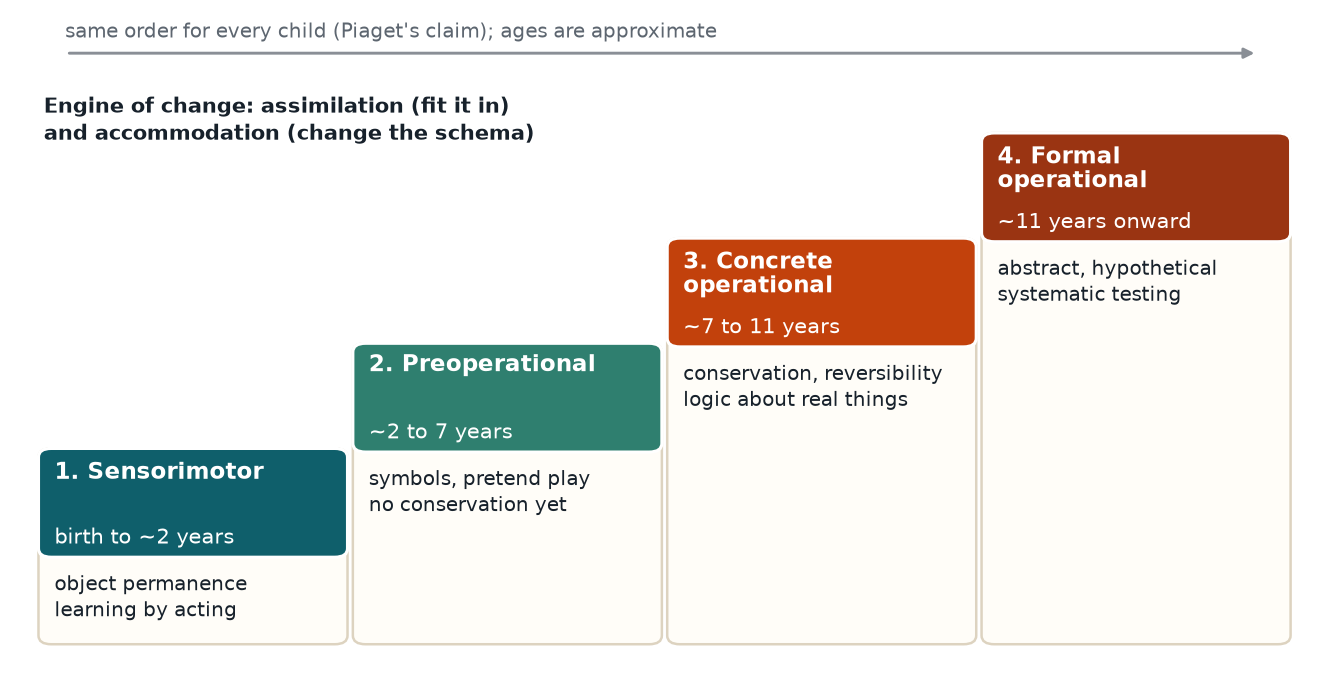
Jean Piaget proposed that children think in qualitatively different ways as they grow, passing in a fixed order through four stages: sensorimotor (birth to about 2), preoperational (about 2 to 7), concrete operational (about 7 to 11), and formal operational (about 11 onward). Children move forward by building mental frameworks called schemas and adjusting them through assimilation and accommodation. To place a child in a stage, look at what the child can and cannot do, not just the age given.
The engine: schemas, assimilation, accommodation
Piaget saw children as active builders of their own knowledge, almost like small scientists testing ideas against the world.
- Schema: an organized pattern of thought or action, such as "things I can suck" or "animals with four legs."
- Assimilation: fitting a new experience into an existing schema without changing it. A toddler who knows "dog" sees a goat and calls it a dog.
- Accommodation: changing a schema, or creating a new one, because the experience does not fit. The toddler learns that the goat is a different animal and splits the old schema in two.
- Equilibration: the drive to restore balance. When assimilation fails and the child feels the mismatch (disequilibrium), accommodation follows, and thinking reorganizes at a higher level.
A quick way to keep these straight: in assimilation the world gets bent to fit the mind, and in accommodation the mind gets bent to fit the world.
The four stages at a glance
Ages are approximate. Piaget's claim was about the order, which he held to be the same for every child, not about exact birthdays.
| Stage | Approximate age | Key achievements | Key limits |
|---|---|---|---|
| Sensorimotor | Birth to 2 | Learns through senses and movement, object permanence, goal-directed action, deferred imitation by the end | No stable mental symbols early on |
| Preoperational | 2 to 7 | Symbolic thought, language explodes, pretend play | Egocentrism, centration, irreversibility, animism, fails conservation |
| Concrete operational | 7 to 11 | Conservation, reversibility, classification, seriation, logic about real objects | Struggles with abstract or hypothetical problems |
| Formal operational | 11 onward | Abstract and hypothetical reasoning, systematic hypothesis testing | Not reached by everyone in every domain |
Stage 1: sensorimotor (birth to about 2)
Infants understand the world through what they can see, grasp, suck, and move. Thought and action are not yet separate.
- Object permanence is the headline milestone: knowing an object still exists when it is out of sight. Piaget saw it emerge at about 8 to 12 months, when infants start searching for a hidden toy, and become complete by about 18 to 24 months, when toddlers can track objects moved out of sight.
- The A-not-B error shows it is still fragile. If a toy is hidden under cloth A several times and then, in full view, moved to cloth B, an infant around 8 to 12 months often searches under A again.
- Piaget described six substages, moving from reflexes, to repeating actions on the body (primary circular reactions), to repeating actions that produce effects in the world (secondary), to deliberate experimenting (tertiary), and finally to mental representation at around 18 to 24 months.
- Deferred imitation, copying an action seen earlier, marks the arrival of mental symbols and the bridge into the next stage.
Stage 2: preoperational (about 2 to 7)
Children can now use symbols: words, drawings, and pretend play where a block becomes a phone. Their reasoning is intuitive rather than logical, and Piaget defined the stage partly by what is missing: "operations," meaning mental actions that can be reversed.
- Egocentrism: difficulty taking another person's viewpoint. In Piaget's three mountains task, a child looks at a model of three mountains and is asked what a doll on the other side sees. Preoperational children tend to pick their own view.
- Centration: focusing on one feature, such as the height of a liquid, and ignoring another, such as the width of the glass.
- Irreversibility: not mentally running an action backward ("if we pour it back, it is the same amount").
- Animism: giving lifelike qualities to objects ("the sun is following me because it likes me").
- Failure of conservation: not understanding that quantity stays the same when only the appearance changes.
A typical conservation test: show a child two identical short glasses with equal juice, then pour one into a tall thin glass. A preoperational child says the tall glass has more. The child is centering on height and cannot reverse the pour mentally.
Stage 3: concrete operational (about 7 to 11)
Children now perform logical operations, as long as the problem involves real or easily imagined objects.
- Conservation appears because the child can decenter (consider two dimensions at once) and reverse an operation.
- Conservation does not arrive all at once. Piaget found that conservation of number and of liquid quantity tends to come first, while conservation of weight and especially volume come later. He called this uneven timing within a stage horizontal décalage.
- Classification: grouping by more than one property, including class inclusion (understanding that there can be more flowers than roses, because roses are a subset of flowers).
- Seriation: arranging items in order along a dimension, such as sticks by length.
- Transitive inference: if Ana is taller than Ben and Ben is taller than Cal, then Ana is taller than Cal.
The limit is abstraction. A concrete operational child can solve the stick problem with real sticks but has trouble with the same logic posed purely in words or symbols about impossible situations.
Stage 4: formal operational (about 11 onward)
Adolescents become able to reason about possibilities, not just realities.
- Hypothetico-deductive reasoning: forming a hypothesis and deducing what should happen if it is true.
- Systematic testing: in the pendulum task (studied by Inhelder and Piaget), the question is what controls how fast a pendulum swings: string length, weight, release height, or force of the push. A formal operational thinker changes one variable at a time and finds that length is what matters. Younger children change several things at once.
- Abstract thought: algebra with symbols, arguments about justice or freedom, and judging a syllogism's logic even when its premises are false.
Piaget himself later acknowledged that many adults use formal reasoning mainly in areas where they have expertise, and some research suggests a substantial share of adults do not reliably show it at all.
How to place a vignette in a stage
Ask these questions in order:
- Is the child acting, not symbolizing? No language, learning by grabbing and mouthing, searching (or not) for hidden objects: sensorimotor.
- Is the child using symbols but fooled by appearances? Pretend play, says the taller glass has more, assumes you see what they see: preoperational.
- Is the child logical about real things but stuck on hypotheticals? Conserves, sorts and orders objects, struggles with "suppose gravity were reversed": concrete operational.
- Is the person reasoning about possibilities and testing variables systematically? Formal operational.
Practice with three short cases:
- A 4-year-old covers her eyes and says "you can't see me now." She assumes others see what she sees, so this is egocentrism: preoperational.
- A 9-year-old insists a flattened ball of clay still has the same amount of clay. Asked "if all cats could bark and Tom is a cat, could Tom bark?", he answers "no, cats meow," reasoning from reality instead of the premise. Conservation is present, reasoning from a false premise is not: concrete operational.
- A 10-month-old watches a ball roll under the couch and crawls after it. The infant knows the ball still exists: sensorimotor, with object permanence emerging.
Criticisms worth knowing
- Infants were underestimated. Studies that measure looking time instead of reaching, such as Renée Baillargeon's violation-of-expectation experiments, suggest some sense of object permanence months earlier than Piaget proposed. Reaching tasks demand motor planning that may hide what infants know.
- Stages are less tidy than described. Children often show a skill in one task and not in a similar one, which fits gradual, domain-specific change better than sudden stage shifts.
- Culture and schooling matter. The timing of concrete and formal skills varies with education and experience, and formal reasoning is not universal.
- The social side was underplayed. Lev Vygotsky argued that thinking develops through interaction with more skilled people. His zone of proximal development is the gap between what a child does alone and what the child can do with help, and scaffolding is the support that bridges it. Piaget pictured the child as a lone scientist; Vygotsky pictured an apprentice.
Common traps
- Mixing up assimilation and accommodation. Calling a goat a dog is assimilation. Learning that goats are their own category is accommodation.
- Placing conservation in the preoperational stage. Failing conservation is preoperational. Achieving it is concrete operational.
- Using age alone. A question may describe an unusually advanced or delayed child. Classify by the behavior described.
- Mixing Piaget with Erikson. Erikson's stages are psychosocial crises across the whole lifespan, covered in the Erikson note. Piaget's stages are about thinking and end in adolescence.
- Crediting Piaget with the imaginary audience and personal fable. These descriptions of adolescent egocentrism come from David Elkind, who built on Piaget's work.
- Assuming formal operations means adult reasoning is always logical. It means the capacity exists, not that it is used everywhere.
One-minute recap
Schemas grow by assimilation (fit new info in) and accommodation (change the schema), driven by equilibration. Sensorimotor, about 0 to 2: learning through action, object permanence, A-not-B error. Preoperational, about 2 to 7: symbols and pretend play, but egocentrism, centration, irreversibility, animism, and no conservation. Concrete operational, about 7 to 11: conservation, reversibility, classification, seriation, logic about real things. Formal operational, about 11 on: abstract, hypothetical, systematic reasoning. The order is the core claim; the ages are rough. Critics say infants know more, stages blur, culture matters, and Vygotsky stressed social learning.
Check yourself: 5-question mini-quiz
1. A 3-year-old who knows "bird" sees a butterfly and calls it a bird. Which process is this?
Assimilation. The child fits the new animal into an existing schema without changing the schema.
2. Which Piagetian stage is marked by first succeeding at conservation tasks?
The concrete operational stage, roughly ages 7 to 11, when children can decenter and mentally reverse an action.
3. An infant repeatedly finds a toy under cloth A, then watches it moved to cloth B but searches under A. What is this called and which stage is it?
The A-not-B error, seen in the sensorimotor stage while object permanence is still fragile, often around 8 to 12 months.
4. In the pendulum task, how does a formal operational thinker differ from a younger child?
The formal operational thinker changes one variable at a time while holding the others constant, and so isolates string length as the cause.
5. What does horizontal décalage describe?
Uneven timing within a stage, such as conservation of number appearing before conservation of volume even though both are concrete operational skills.
Keep studying
- Erikson's 8 Stages of Psychosocial Development Explained
- Types of Memory for the MCAT: Sensory, Short-Term, Working, Long-Term
- Classical vs Operant Conditioning: Differences, Terms and Examples
- All free notes
Launch list
Get launch day access
StudyStore packs are available soon; checkout is not open yet. Join the list and we send you one email the day it opens.
Free right now: the free sampler of study notes and practice questions.
You are on the list.
We will send one email when checkout opens. While you wait, start with the free sampler notes.