Free MCAT study note
Role Strain vs Role Conflict, Status Types and Social Groups
Role strain is tension inside a single role, when that one role makes demands that are too heavy or that contradict each other. Role conflict is tension between two or more roles a person holds, when meeting one role's demands means failing another's. The quick test is to ask how many roles the competing demands come from: a single role points to strain, several roles point to conflict. Both ideas sit on top of a small vocabulary of statuses, roles and groups, so this note builds that vocabulary first and then works through examples.
Status: the position
A status is a recognized position in a society, such as student, sister, nurse or neighbor. A status says where you stand, not what you do.
- Ascribed status: given to you by birth or by other people, without any choosing on your part. Age, sex, race, ethnicity and family of origin are standard examples. Ascribed does not mean permanent: age changes every year, and it is still ascribed.
- Achieved status: earned or chosen through your own actions. Graduate, physician, marathon runner, parent and convicted felon are all achieved.
- Master status: the one status that dominates how others see you and overshadows the rest. It can be ascribed (a visible disability, race in a racially stratified society) or achieved (senator, Olympic champion, ex-convict). The label comes from how much it overshadows everything else, regardless of whether it was assigned or earned.
All the statuses one person holds at a given time form the status set. Status inconsistency occurs when a person's statuses rank very differently, such as someone with a doctorate working as a parking attendant.
Role: the performance
A role is the bundle of duties, behaviors and expectations that comes with a status. Status is the part you are cast in; role is how that part is expected to be played. A single status carries several role relationships: a teaching assistant relates differently to students, to the professor and to other teaching assistants. That cluster of roles tied to one status is the role set, which is different from the status set.
Role strain vs role conflict
| Role strain | Role conflict | |
|---|---|---|
| Where the tension lives | Inside one role | Between two or more roles |
| Number of roles | One | Two or more |
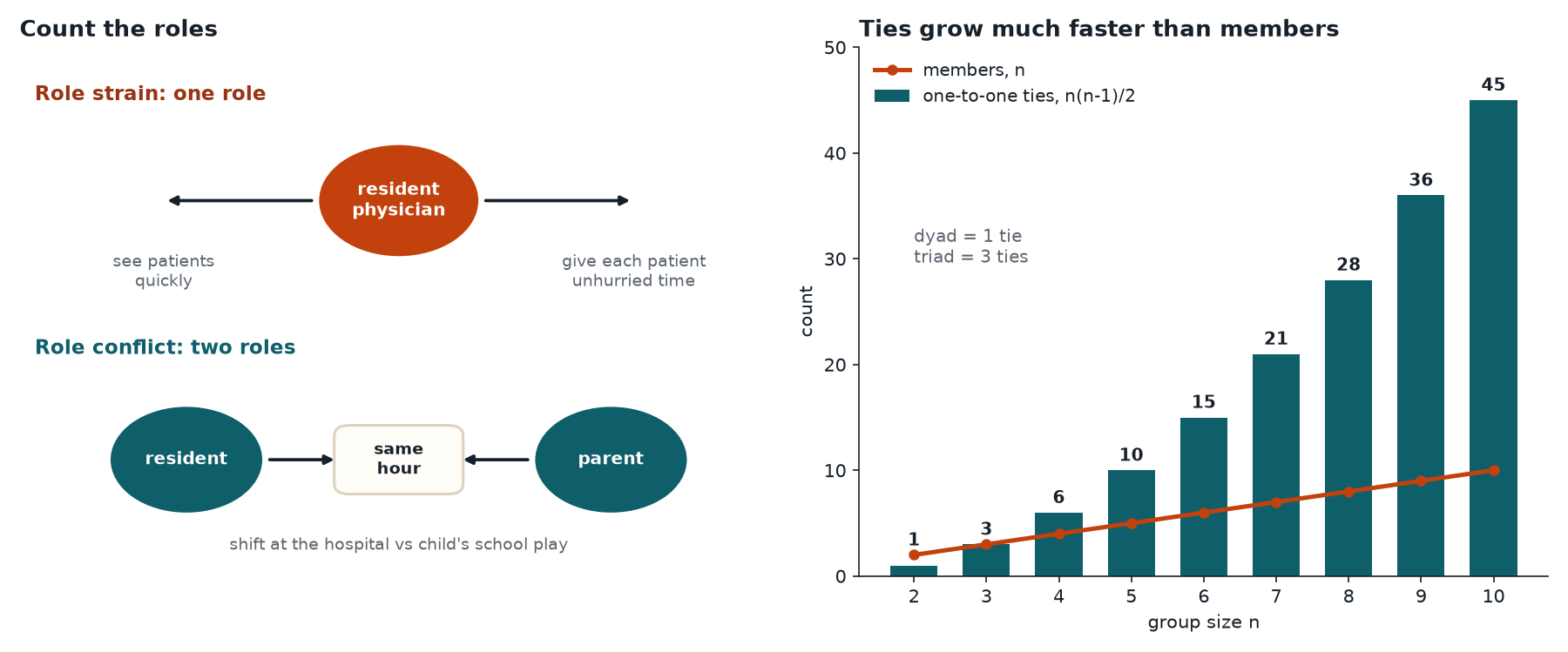
| Example | A resident physician expected both to see patients quickly and to spend unhurried time with each | A resident who is also a parent, needed at the hospital and at a child's school play at the same hour |
| Typical fix | Reprioritize within the role | Choose between roles, compartmentalize or drop a role |
The term role strain is associated with the sociologist William Goode, who also described how people cope by bargaining over which obligations to meet first and which to let slide.
Role exit
Role exit describes leaving behind a role that had been a core part of who you were, as with retiring athletes, former nuns, divorced spouses or people leaving the military. Helen Ebaugh described it as moving from doubts, to searching for alternatives, to a turning point, to building an ex-role identity. The key idea is that people keep carrying parts of the old role ("I'm a former Marine"), so role exit is about identity, not just a schedule change.
Groups
A social group is at least two people who interact on a regular basis, feel they belong together, and share some identity or goals. A crowd waiting for a bus is an aggregate, not a group: they share space but not identity.
Primary vs secondary groups
Charles Horton Cooley called primary groups the small, close, long-lasting groups that shape who we are, such as family and close friends. Relationships in them are expressive: they are valued for themselves. Secondary groups are larger, more impersonal and often temporary, such as coworkers, a lecture class or a professional association. Relationships in them are instrumental: they exist to get something done. A secondary group can turn into a primary one, as when coworkers become close friends.
Ferdinand Tonnies drew a related distinction between Gemeinschaft, a close-knit community bound by kinship and tradition, and Gesellschaft, a large society held together by impersonal, contract-like relationships.
In-groups, out-groups and reference groups
- In-group: a group you belong to and feel loyalty toward. Out-group: a group you do not belong to and may view with competition or suspicion. William Graham Sumner introduced the pair. People often perceive members of other groups as all the same (out-group homogeneity), which feeds stereotypes, and they explain group outcomes in self-flattering ways, an extension of the self-serving pattern described in the note on attribution biases.
- Reference group: a group you use as a standard to judge your own attitudes, behavior or success. You do not have to belong to it. A pre-med student who compares herself with admitted medical students is using them as a reference group.
Group size: dyads and triads
Georg Simmel noted that group size changes how a group works. With only two members, a dyad offers the closest bond but is the easiest to break: one departure dissolves it. Adding a third person makes a triad, which holds together better because someone can mediate, yet it opens the door for two members to side against the third. Groups also pull members toward agreement, which is where conformity and obedience come in.
Worked example: counting ties as a group grows
For n people, the count of possible one-to-one relationships is n(n-1)/2, because each of the n members can pair with n - 1 others and each pair is counted twice.
| Group size n | Ties n(n-1)/2 |
|---|---|
| 2 (dyad) | 1 |
| 3 (triad) | 3 |
| 5 | 10 |
| 6 | 15 |
| 12 | 66 |
Question. A lab group grows from 6 to 12 members. By what factor do the possible ties increase?
Solution. Ties go from 6 x 5 / 2 = 15 to 12 x 11 / 2 = 66. The factor is 66 / 15 = 4.4. Doubling the group more than quadrupled the number of relationships to maintain, which is one reason larger groups lean on formal rules, leaders and subgroups.
Worked example: classify the scenario
- A police officer is asked to enforce a law against a close friend. Two statuses, officer and friend, make incompatible demands. Role conflict.
- A professor is expected to publish heavily and also to give students extensive one-on-one attention. Both demands come from the single role of professor. Role strain.
- A wheelchair user finds that strangers notice the wheelchair before her career as an architect. Disability is operating as her master status, here an ascribed one.
- A retired surgeon still introduces himself by his old title and struggles with free time. He is going through role exit and building an ex-role identity.
- A high school basketball player models his training on professional athletes he has never met. The professionals are his reference group.
Common traps
- Calling any overloaded person "role conflict." If every competing demand belongs to the same role, it is role strain.
- Assuming master status must be ascribed. Achieved statuses such as celebrity or criminal record can dominate just as easily.
- Equating ascribed with unchangeable. Age is ascribed even though it changes.
- Mixing up status set and role set. Status set is all your positions; role set is all the role relationships attached to one position.
- Thinking you must belong to a reference group. You only have to compare yourself with it.
- Primary vs secondary by size alone. The defining features are intimacy, duration and expressive ties, not just headcount.
One-minute recap
- A status is where you stand; a role is what that position asks of you.
- Ascribed is assigned, achieved is earned, master status dominates others' view and can be either.
- Role strain: one role, competing demands. Role conflict: two or more roles colliding. Role exit: disengaging from a core role and rebuilding the self around an ex-role.
- Primary groups are close and expressive; secondary groups are impersonal and instrumental.
- In-group vs out-group is belonging; a reference group is a yardstick you need not belong to.
- Dyads are intimate but fragile, triads are stabler and allow coalitions; ties grow as n(n-1)/2.
Check yourself: 5-question mini-quiz
1. A nurse is expected to chart every detail thoroughly and also to see more patients per shift than charting allows. Is this role strain or role conflict?
Role strain. Both competing demands come from the single role of nurse, so the tension is inside one role.
2. A city council member must vote on a contract that would benefit her brother's company. Is this role strain or role conflict?
Role conflict. Her roles as council member and as sister make incompatible demands on the same decision.
3. Can a master status be achieved rather than ascribed? Give an example.
Yes. Any status that overshadows the others in how people see you qualifies, so an achieved status such as being a famous athlete or a convicted felon can be one.
4. How many possible one-to-one ties exist in a group of 8 people?
- Using n(n-1)/2, the group has 8 x 7 / 2 = 28 pairwise ties.
5. A group that a person uses as a standard for judging her own success, without belonging to it, is called what?
A reference group. People compare themselves with it whether or not they are members.