Free MCAT study note
Theories of Emotion: James-Lange vs Cannon-Bard vs Schachter-Singer
The classic theories of emotion disagree about one thing: the order of events. James-Lange says bodily arousal comes first and the feeling is your perception of that arousal. Cannon-Bard says arousal and feeling happen at the same time, triggered in parallel by the brain. Schachter-Singer (two-factor theory) says arousal is generic and you need a cognitive label from the situation to know which emotion you feel. Lazarus says a cognitive appraisal of the event comes first and drives both the feeling and the body's response. If you can write each sequence from memory, most questions on this topic become a matching exercise.
The theories at a glance
| Theory | Sequence | Where the emotion starts | Does arousal differ by emotion? |
|---|---|---|---|
| James-Lange | Event → arousal → feeling | Body (peripheral) | Yes, each emotion has its own bodily pattern |
| Cannon-Bard | Event → thalamus → arousal and feeling at once | Brain (central) | No, arousal is too similar across emotions |
| Schachter-Singer | Event → arousal + cognitive label → feeling | Body plus interpretation | No, arousal is general; the label decides |
| Lazarus (appraisal) | Event → appraisal → feeling and arousal | Thought | Arousal follows the appraisal |
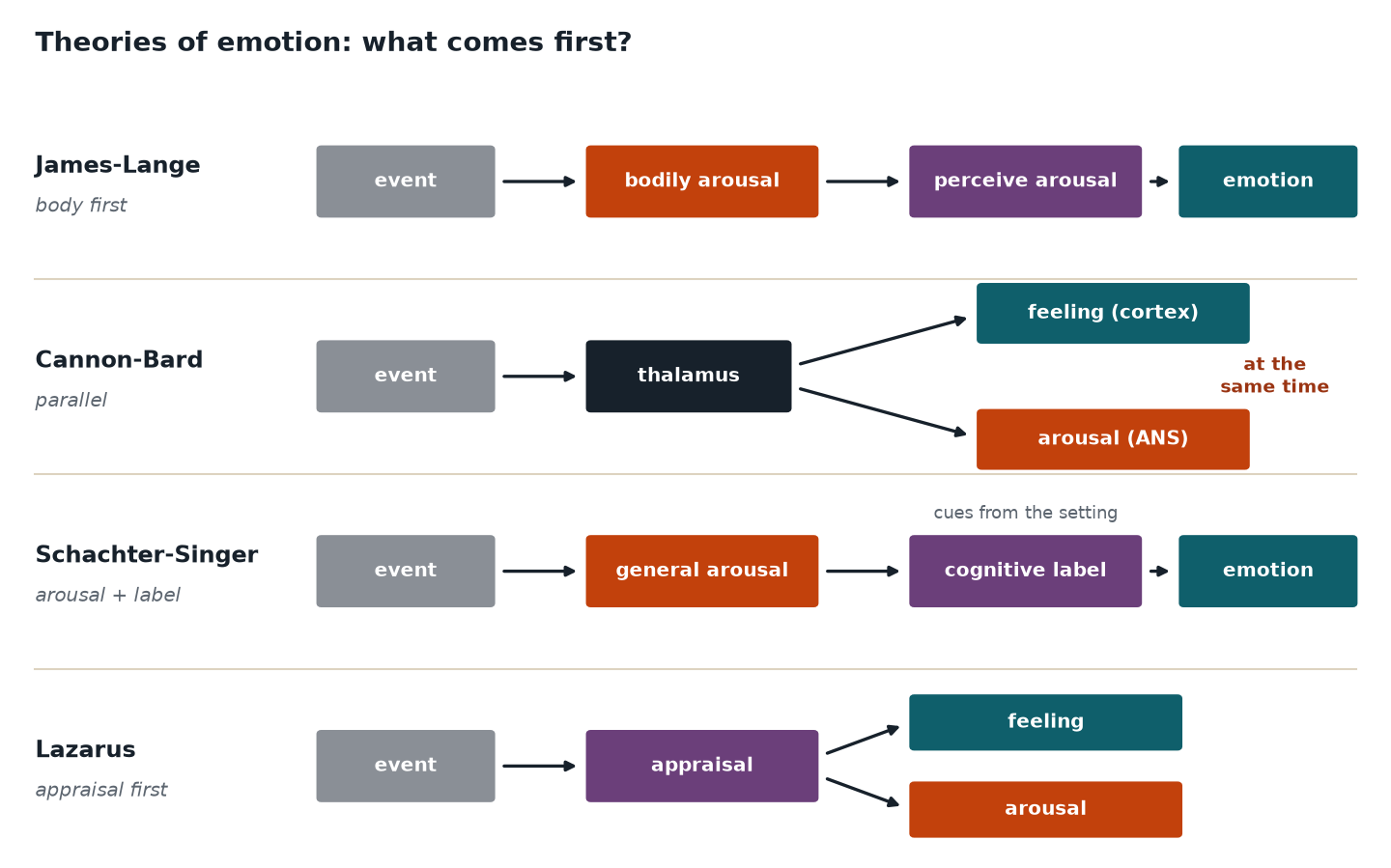
James-Lange: the body leads
William James and Carl Lange, writing independently in the 1880s, proposed that an emotion is the perception of bodily changes. You hear a loud crash in a dark house. Your heart races, your muscles tense and you freeze, and noticing those changes is the fear. In James's famous reversal, we do not tremble because we are afraid; we are afraid because we tremble.
Two predictions follow. First, different emotions should come with different patterns of bodily response, since the body is what distinguishes them. Second, reducing feedback from the body should blunt emotion.
Support. The facial feedback hypothesis is a descendant of this idea: posing a facial expression can nudge the matching feeling, although the size and reliability of the effect are debated. Work on interoception, the sense of the body's internal state, also links bodily awareness to emotional experience.
Critique. Studies of people with spinal cord injuries, which cut much of the feedback from the body, have produced mixed results rather than a clear loss of emotion. That leads to the next theory.
Cannon-Bard: brain first, in parallel
Walter Cannon, later joined by Philip Bard, argued against James-Lange in the 1920s. His main objections:
- The internal organs respond too slowly to be the source of a feeling that arises almost instantly.
- Very different emotions, such as fear and rage, produce broadly similar sympathetic arousal, so arousal alone cannot tell them apart.
- Animals whose internal organs were surgically disconnected from the brain still showed emotional behavior.
Cannon-Bard proposes that a stimulus is relayed by the thalamus to two places at once: the cortex, producing the conscious feeling, and the hypothalamus and autonomic nervous system, producing bodily arousal. The two outputs run in parallel, so neither causes the other. This makes it a central theory, in contrast to the peripheral James-Lange view. The specific anatomy has been revised since (the amygdala and other limbic structures play major roles), but the parallel-pathway idea is what exam questions target.
Schachter-Singer: arousal plus a label
Stanley Schachter and Jerome Singer proposed the two-factor theory in 1962. Factor one is physiological arousal, which they treated as general and similar across emotions. Factor two is a cognitive label, an explanation the person draws from the situation. The emotion is the combination.
In their study, participants were injected with epinephrine (which causes arousal) or a placebo and given different information about what the injection would do. They then waited with a confederate who acted either euphoric or irritated. Participants who were aroused but had no accurate explanation for it tended to take on the confederate's mood. Participants who had been told to expect a racing heart showed less of this effect, because they already had a label: the drug. Later attempts to replicate the study produced mixed results, but the core idea of misattribution of arousal has lasting influence.
Misattribution means arousal from one source gets credited to another. Arousal from a scary situation can be read as attraction, and leftover arousal from exercise can intensify a later burst of anger, an idea called excitation transfer. The theory also connects emotion to attribution, the same process of explaining causes discussed in the attribution bias note.
Lazarus and Zajonc: does thinking come first?
Richard Lazarus put cognition at the very start. His cognitive appraisal theory says you first judge what an event means for your well-being, and that judgment produces both the feeling and the physiological response. The same email from a supervisor can produce fear, relief or irritation depending on how you appraise it. Notice the difference from Schachter-Singer: Lazarus starts with appraisal, while two-factor theory starts with arousal that then needs a label.
Robert Zajonc argued the opposite: some emotional reactions occur before, and without, conscious thought. His evidence included the mere-exposure effect, in which people come to prefer stimuli they have seen before even when they cannot recall seeing them. Neuroscience offers a plausible route: sensory information can reach the amygdala through a fast path from the thalamus before the cortex finishes processing it. The Lazarus-Zajonc debate is usually framed as "cognition first" versus "affect first," and the honest answer is that both routes probably exist.
How to identify the theory in a question stem
Ask three questions in order:
- Does the stem say the person noticed a bodily change and then felt the emotion? James-Lange.
- Does it say the feeling and the arousal arose at the same moment, or mention the thalamus sending signals to both? Cannon-Bard.
- Does it involve unexplained arousal that the person interprets using cues from the setting? Schachter-Singer. If instead the person first evaluates the meaning of the event, with no mention of pre-existing arousal, it is Lazarus.
Worked example 1: four scenarios
- Marcus realizes his palms are sweating and his heart is pounding during a job interview, and only then concludes that he is nervous. James-Lange: the bodily change was noticed first and became the emotion.
- Priya sees a car swerve toward her; she feels terror and her heart leaps in the same instant. Cannon-Bard: feeling and arousal arise together.
- After two cups of strong coffee, Dev feels jittery. At a surprise party he decides the jitters are excitement. Schachter-Singer: arousal from one source, labeled using the setting.
- Lena reads that her exam was moved earlier. She judges that she is unprepared and cannot reschedule, and then she feels anxious and tense. Lazarus: the appraisal of meaning comes first.
Worked example 2: predicting a misattribution study
Imagine a hypothetical study. Group 1 rides an exercise bike for five minutes, waits a short time, and then hears a mildly insulting comment. Group 2 rests before hearing the same comment. Both groups rate their anger.
- Schachter-Singer predicts Group 1 reports more anger, if participants no longer link their lingering arousal to the exercise. The leftover arousal gets labeled as anger because the insult is the obvious cause available.
- If Group 1 is reminded right before the insult that exercise raises heart rate, two-factor theory predicts the difference shrinks, because the arousal now has a correct label.
- Cannon-Bard would not predict a difference driven by misattribution, since it treats felt emotion as independent of bodily arousal.
The comparison shows why the "informed" condition matters in two-factor designs: giving people an accurate explanation is how researchers test whether the label, not the arousal alone, shapes the emotion.
Common traps
- Calling Cannon-Bard sequential. Arousal and feeling are simultaneous and parallel. Neither causes the other.
- Mixing up peripheral and central. James-Lange is the peripheral theory (the body). Cannon-Bard is the central theory (the brain, via the thalamus).
- Saying Schachter-Singer has emotion-specific arousal. It is the reverse. Arousal is general, and the cognitive label supplies the specific emotion. James-Lange is the theory with emotion-specific bodily patterns.
- Confusing Schachter-Singer with Lazarus. Both involve cognition. Two-factor theory starts with arousal, then labels it. Lazarus starts with appraisal, which then causes arousal.
- Treating any theory as fully confirmed. Each captures part of the picture. The original studies have known limitations.
One-minute recap
James-Lange: event, arousal, feeling; the body leads and each emotion has its own pattern. Cannon-Bard: the thalamus triggers feeling and arousal at the same time; central and parallel. Schachter-Singer: general arousal plus a cognitive label from the setting; misattribution of arousal. Lazarus: appraisal of meaning comes first and drives feeling and arousal. Zajonc: some emotional reactions precede cognition. To classify a stem, find what comes first.
Check yourself: 5-question mini-quiz
1. Which theory holds that you feel sad because you notice yourself crying?
James-Lange. It proposes that the perception of a bodily response is the emotion, so the body change comes first.
2. According to Cannon-Bard, what is the relationship between physiological arousal and the conscious feeling of an emotion?
They occur at the same time, triggered in parallel by the thalamus. Neither causes the other.
3. In a two-factor study, aroused participants who were told what physical symptoms to expect showed less mood copying. Why?
They already had an accurate explanation for their arousal, so they did not need to take a label from the confederate's behavior.
4. How does Lazarus's theory differ from Schachter-Singer's in its first step?
Lazarus begins with a cognitive appraisal of the event, which then produces arousal and feeling. Schachter-Singer begins with arousal, which is then given a cognitive label.
5. Which of Cannon's objections targets the idea that each emotion has its own bodily signature?
The objection that different emotions, such as fear and anger, produce broadly similar sympathetic arousal, so arousal alone cannot distinguish them.