Free MCAT study note
Types of Social Mobility and Stratification for the MCAT
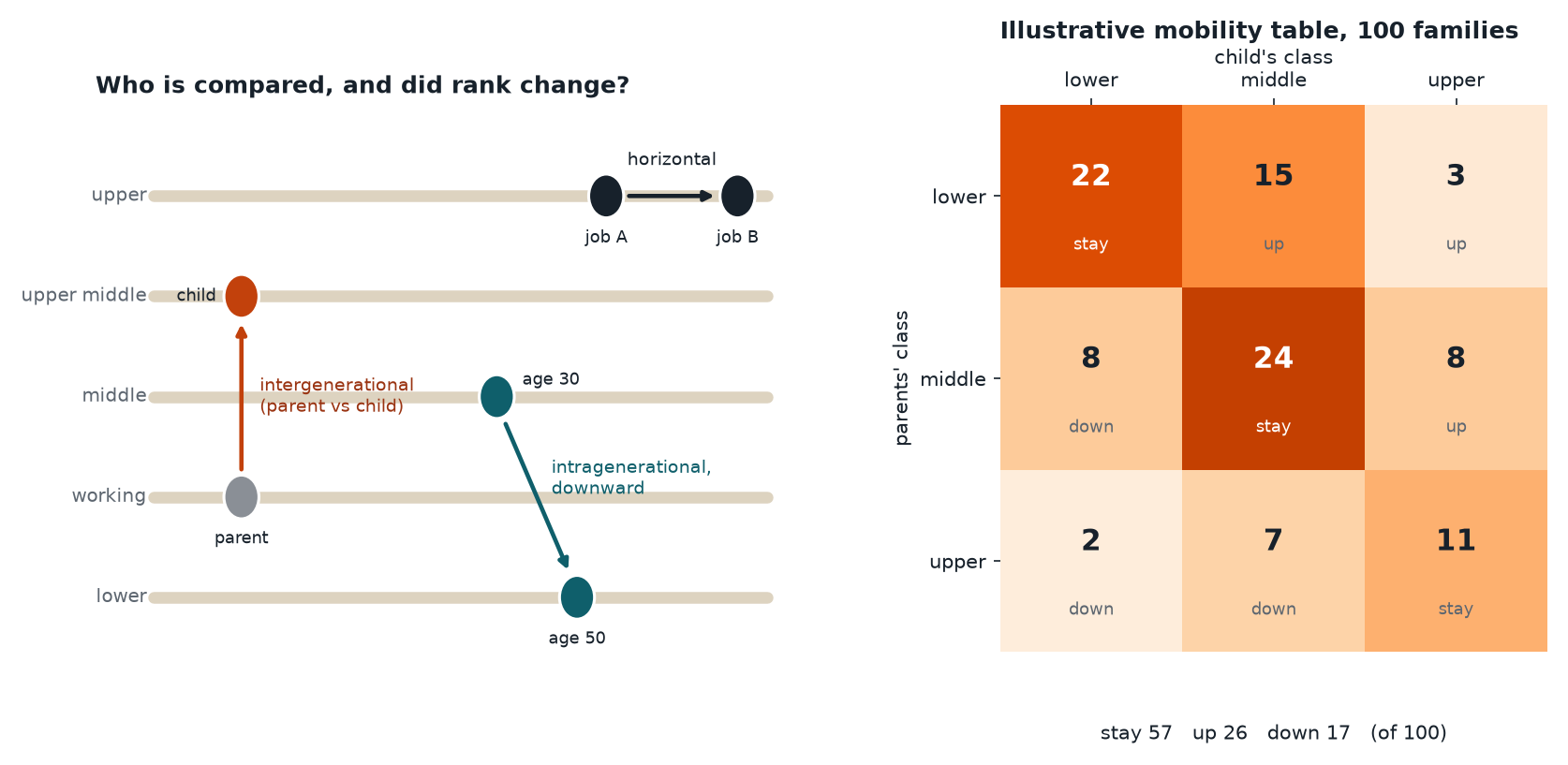
Social stratification is the ranking of people into layers with unequal access to wealth, power and prestige. Social mobility is movement between those layers. Mobility is classified along a few independent axes: vertical (up or down in rank) vs horizontal (a change of position at the same rank), intergenerational (a child compared with a parent) vs intragenerational (one person over a lifetime), and structural (many people moved by changes in the economy) vs exchange (people trading places while the overall structure stays the same). Most questions in this area are solved by asking two things: who is being compared with whom, and did rank change?
Stratification systems: how open is the ladder?
How much mobility is possible depends on the kind of stratification system.
| System | Basis of position | Openness | Example |
|---|---|---|---|
| Caste | Birth (ascribed), often tied to religion or tradition | Closed: little or no movement, marriage within the caste | Traditional caste systems, such as the one historically found in India |
| Estate | Birth and relationship to land | Mostly closed | Feudal Europe: nobility, clergy, peasantry |
| Class | Largely economic, partly achieved | Open to some degree: movement is possible but unequal | Modern industrial societies |
Two related terms come up constantly:
- Ascribed status is assigned at birth or by circumstances you did not choose, such as family of origin, race or sex.
- Achieved status is earned through effort or choices, such as a profession or a degree.
A meritocracy would assign positions purely by achieved traits such as talent and effort. Real class systems mix both: achieved credentials matter, but ascribed starting points shape who can earn them. The word itself was popularized by the sociologist Michael Young in a 1958 satire that warned against the idea, not one that praised it.
Why is there stratification at all?
- The Davis-Moore thesis (1945) is the functionalist answer: societies must persuade the most capable people to fill the most important and demanding jobs, and unequal rewards do that.
- Conflict theorists answer that inequality persists because those at the top use their resources to protect their position. Marx defined class by ownership of the means of production; Weber added that class, status and party (wealth, prestige and power) are separate rankings. When a person ranks high on one and low on another, such as a professor with high prestige and modest income, that is status inconsistency.
For a full comparison of these lenses, see functionalism vs conflict theory vs symbolic interactionism.
The types of social mobility
Vertical vs horizontal
- Vertical mobility is a change in rank. It can be upward (a clerk becomes an attorney) or downward (a business owner goes bankrupt and takes hourly work).
- Horizontal mobility is a change in position without a change in rank: a nurse moves from one hospital to another at the same pay and prestige, or an accountant becomes a budget analyst at a similar level.
Intergenerational vs intragenerational
- Intergenerational mobility compares a person's position with their parents'. A child of a janitor who becomes an engineer shows upward intergenerational mobility.
- Intragenerational mobility tracks one person across their own life. A line cook who becomes a restaurant owner twenty years later shows upward intragenerational mobility.
These two axes combine. A single move can be both vertical and intragenerational, for example.
Structural vs exchange
- Structural mobility happens when the economy itself changes the number of positions at each level, moving many people at once. When manufacturing jobs disappear, many workers move down regardless of their individual effort. When a new industry creates many professional jobs, many people move up.
- Exchange mobility (also called circulation mobility) is movement that leaves the shape of the structure unchanged: for each family that rises, another falls.
Absolute vs relative
- Absolute mobility asks whether children are better off than their parents in real terms, for example inflation-adjusted income. One widely cited analysis by Raj Chetty and colleagues estimated that about 90 percent of Americans born in 1940 out-earned their parents, compared with about 50 percent of those born in 1980.
- Relative mobility asks whether children's rank differs from their parents' rank. Everyone can become richer (high absolute mobility) while rank stays sticky (low relative mobility).
Across wealthy countries, those with higher income inequality tend to have lower intergenerational mobility. This pattern was nicknamed the Great Gatsby Curve by the economist Alan Krueger, drawing on work by Miles Corak. It is a correlation across countries, not proof that inequality directly causes low mobility.
Worked example: reading a mobility table
Sociologists summarize intergenerational mobility with a mobility table: rows are parents' class, columns are children's class, and each cell counts families. Here is an illustrative table for 100 families (invented numbers for practice, not real data):
| Parents' class | Child lower | Child middle | Child upper | Row total |
|---|---|---|---|---|
| Lower | 22 | 15 | 3 | 40 |
| Middle | 8 | 24 | 8 | 40 |
| Upper | 2 | 7 | 11 | 20 |
| Column total | 32 | 46 | 22 | 100 |
Step 1: immobility. The diagonal (22 + 24 + 11) holds 57 children who ended in the same class as their parents.
Step 2: upward and downward. Cells above the diagonal are upward moves: 15 + 3 + 8 = 26. Cells below are downward: 8 + 2 + 7 = 17. Total mobility is 26 + 17 = 43, and 57 + 43 = 100 checks out.
Step 3: structural vs exchange. Compare the row totals (parents) with the column totals (children). The lower class shrank from 40 to 32, the middle grew from 40 to 46 and the upper grew from 20 to 22. Even if no one swapped places, at least (|40 − 32| + |40 − 46| + |20 − 22|) / 2 = (8 + 6 + 2) / 2 = 8 moves were forced by the changed shape of the structure. That is one simple estimate of structural mobility. The remaining 43 − 8 = 35 moves are exchange mobility.
Step 4: relative chances. A child from the upper class has 11 / 20 = 55% odds of staying upper. A child from the lower class has 3 / 40 = 7.5% odds of reaching the upper class. The upper-origin child is about 7.3 times as likely to end up upper. That gap in chances, not the overall amount of movement, is what relative mobility describes.
So this society shows plenty of movement and a little structural upgrading, but origin still strongly predicts destination.
How mobility connects to health and opportunity
Mobility is not just an economics topic. Socioeconomic status (SES), a combination of income, education and occupation, tracks health at every step of the ladder, a pattern called the social gradient in health. Two directions of influence are possible: low SES can damage health (social causation), and poor health can push people down the ladder (health selection; the drift hypothesis is one version of this idea). Barriers to upward mobility include unequal school funding, the glass ceiling (invisible barriers that block advancement near the top), and the transmission of advantages across generations through wealth, networks and cultural capital, Bourdieu's term for the knowledge, tastes and credentials that institutions reward.
Common traps
- Mixing up the two time axes. If the comparison is parent vs child, it is intergenerational. If it is the same person at two times, it is intragenerational. The prefixes help: inter means between (between generations), intra means within (within one lifetime).
- Calling every job change vertical. A move to a new employer at the same rank, pay and prestige is horizontal.
- Treating structural mobility as individual achievement. If a whole industry rises or collapses, the movement is structural, even though each person experiences it individually.
- Confusing absolute and relative mobility. A child can earn more than a parent (absolute upward) while staying at the same percentile (no relative change).
- Calling caste systems "class systems with low mobility." Caste is closed and ascribed by birth; class is open, at least in principle.
- Putting Davis-Moore in the conflict camp. Davis-Moore is functionalist; its critics are conflict theorists.
- Reading the Great Gatsby Curve as causal. It is a cross-country correlation.
One-minute recap
- Stratification ranks people by wealth, power and prestige. Caste and estate systems are closed and ascribed; class systems are open to some degree.
- Vertical = rank changes (up or down). Horizontal = new position, same rank.
- Intergenerational = child vs parent. Intragenerational = one person over time.
- Structural = economy changes the number of positions. Exchange = people trade places.
- Absolute = better off than parents. Relative = different rank than parents.
- Mobility table: diagonal = immobile, above = upward, below = downward.
Check yourself: 5-question mini-quiz
1. A woman whose father was a factory worker becomes a hospital administrator. What type of mobility is this?
Upward vertical intergenerational mobility. She is being compared with her parent, and her rank is higher than his.
2. A pharmacist leaves one chain pharmacy for another at the same salary and title. What type of mobility is this?
Horizontal mobility (and, since it is one person's career, intragenerational). Her position changed but her rank in the stratification system did not.
3. When automation eliminates thousands of factory jobs and many workers move into lower-paid service work, what kind of mobility is this called?
Structural (downward) mobility. A change in the economy altered the number of positions available, moving many people at once regardless of individual effort.
4. In a mobility table where rows are parents' class and columns are children's class, what do the cells on the diagonal represent?
Immobility. They count children who ended up in the same class as their parents.
5. Which theory argues that unequal rewards are necessary to motivate the most talented people to fill the most important jobs?
The Davis-Moore thesis, a functionalist explanation of stratification. Conflict theorists criticize it for ignoring how inherited advantage shapes who gets those jobs.