Free MCAT study note
Reinforcement Schedules Explained: FR, VR, FI and VI
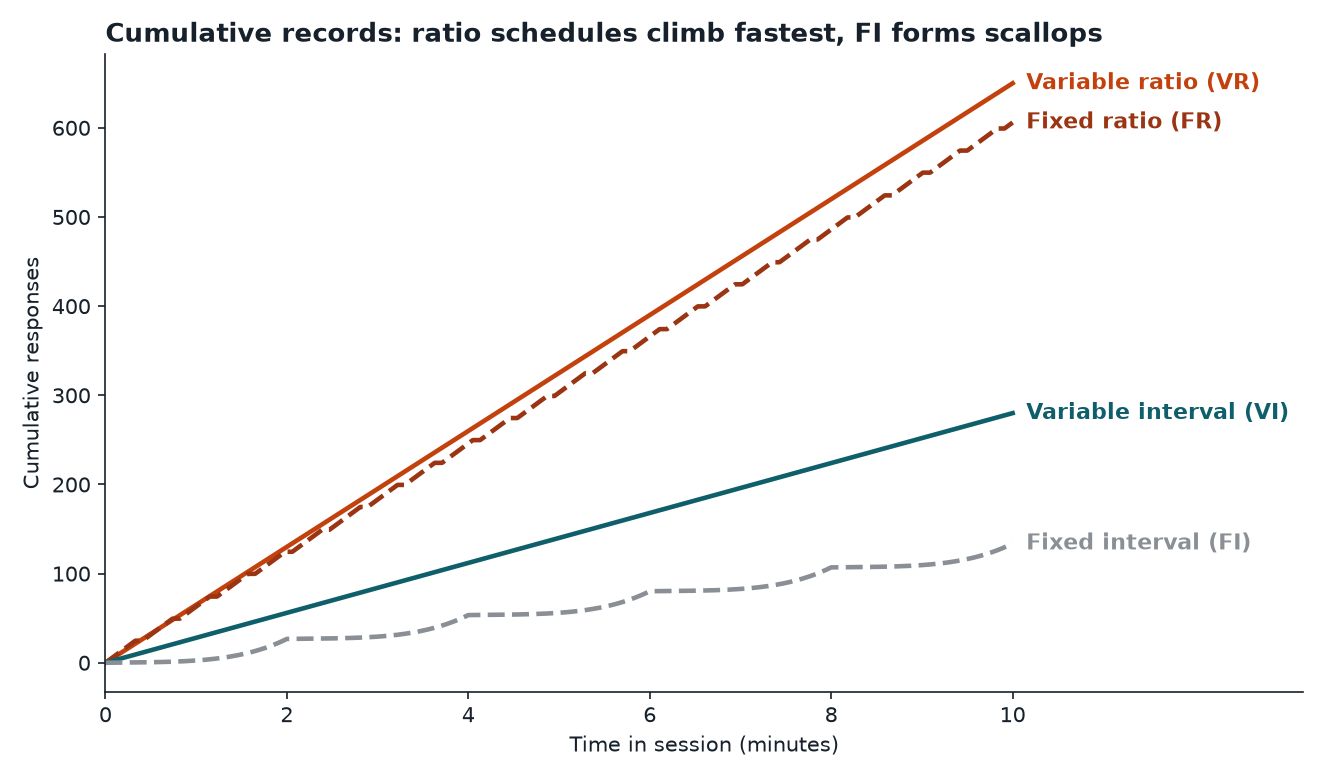
A reinforcement schedule is the rule that decides which responses earn a reinforcer. Ratio schedules pay off after a number of responses, interval schedules pay off for the first response after some time has passed, and each can be fixed or variable. Variable ratio produces the highest, steadiest responding and the most resistance to extinction; fixed interval produces the lowest overall rate with a burst near the end of each interval.
Continuous versus partial reinforcement
Under continuous reinforcement, every correct response is reinforced. That is the fastest way to teach a brand new behavior, because the link between response and outcome is unmistakable. The weakness shows when reinforcement stops: the change is obvious, so the behavior fades quickly.
Partial (intermittent) reinforcement rewards only some responses. Learning is slower at first, but the behavior lasts far longer once rewards end. This is the partial reinforcement extinction effect: a learner used to long stretches without payoff cannot easily tell that payoff has stopped for good. A practical recipe follows from it: start with continuous reinforcement to establish a behavior, then thin to a partial schedule to maintain it.
The four partial schedules
Two questions name any schedule. First, does the reward depend on how many responses were made (ratio) or on how much time has passed (interval)? Second, is the requirement constant (fixed) or does it change unpredictably around an average (variable)?
| Schedule | Rule | Typical response pattern | Resistance to extinction |
|---|---|---|---|
| Fixed ratio (FR) | Reward after every n responses | High rate, brief pause right after each reward | Moderate |
| Variable ratio (VR) | Reward after an unpredictable number, averaging n | Highest, steady rate, few pauses | Highest |
| Fixed interval (FI) | First response after a set time is rewarded | Low after reward, speeds up as the time nears (scallop) | Lower |
| Variable interval (VI) | First response after an unpredictable time is rewarded | Moderate, steady rate | High |
Fixed ratio
A worker paid for every 25 envelopes stuffed is on an FR 25 schedule. Because every response moves the worker closer to the next payoff, responding is fast. Right after a payoff, though, there is often a short post-reinforcement pause, since the next reward is a full block of work away. On a cumulative record this looks like steep runs separated by flat steps.
Variable ratio
A slot machine that pays on average once every 30 pulls, but never on a predictable pull, is a VR 30 schedule. The very next response might be the winner, so there is no reason to pause. That gives the highest steady rate of any schedule and the strongest resistance to extinction, which is why games of chance and sales commissions that depend on unpredictable customers keep people working.
Fixed interval
A biology instructor who gives a quiz every Friday creates an FI schedule for studying: studying on Saturday earns nothing extra for a week. Students tend to study little early in the week and a lot on Thursday. The cumulative record shows a scallop: flat just after the reward, curving upward as the interval ends.
Variable interval
Checking for a reply to a message is a good VI example. Replies arrive after unpredictable delays, and only the first check after a reply arrives is rewarded. Because a reward could become available at any time, people check at a moderate, steady pace with no long pauses.
Worked example: why ratio schedules drive faster responding
A rat presses a lever 40 times per minute for a 30-minute session. Compare an FR 20 schedule with an FI 30-second schedule.
- Total presses: 40 × 30 = 1200.
- FR 20: 1200 / 20 = 60 reinforcers.
- FI 30 s: one reinforcer is available every 30 seconds, so at most 30 × 2 = 60 reinforcers. Responding often enough to collect each one soon after it becomes available earns close to that maximum.
Now suppose the rat slows to 20 presses per minute.
- Total presses: 20 × 30 = 600.
- FR 20: 600 / 20 = 30 reinforcers. Halving the rate halved the payoff.
- FI 30 s: still up to 60 reinforcers, because 20 presses per minute is far more than the one press per 30 seconds the schedule needs.
Under a ratio schedule, payoff is proportional to effort, so faster responding is rewarded directly. Under an interval schedule, payoff is capped by the clock, so extra responses earn nothing. That single difference explains why ratio schedules produce higher rates than interval schedules.
Common traps
- Paycheck examples. A salary paid every two weeks is often labeled FI, but pay arrives whether or not you work extra that day. Read what the stem says the reward depends on: a count of responses, the first response after a time, or neither.
- "Variable" is not "random reward for nothing." The reward still depends on responding. A VI schedule rewards the first response after an unpredictable delay, not the passage of time alone.
- Highest rate versus most resistant. VR wins both. If a question asks which schedule is most resistant to extinction, the answer is variable ratio, not variable interval.
- Continuous reinforcement is not the most durable. It produces the fastest learning and the fastest extinction.
- Scallop belongs to FI only. A pause after each reward with a steep run afterward is FR. A curve that starts flat and bends upward before each reward is FI.
- Reinforcement means the behavior increases. A schedule of punishment is not a reinforcement schedule. See negative reinforcement vs punishment for that distinction, and classical vs operant conditioning for where schedules fit in operant learning.
The 7C Learning and Behavior Change pack adds flashcards and practice questions on conditioning, observational learning and attitude change, and you can try a free sampler first.
One-minute recap
- Ratio means a count of responses, interval means time since the last reward. Fixed is constant, variable is unpredictable around an average.
- VR: highest steady rate, most resistant to extinction. FR: high rate with a pause after each reward.
- FI: scalloped pattern, lowest overall rate. VI: moderate steady rate.
- Continuous reinforcement teaches fastest and extinguishes fastest. Partial reinforcement lasts longer.
- Ratio schedules reward faster responding directly; interval schedules cap reward by the clock.
Check yourself: 5-question mini-quiz
1. A fundraiser earns a bonus after every 15 donation pledges and usually takes a short break right after each bonus. Which schedule is this?
Fixed ratio 15. The reward depends on a constant number of responses, and the brief pause after each reward is the typical FR pattern.
2. Which schedule produces the most resistance to extinction?
Variable ratio. Because any response might be rewarded, the learner cannot easily detect that rewards have stopped.
3. A student studies little after each monthly exam and much more in the days before the next one. What schedule and pattern does this show?
A fixed interval schedule with its scalloped pattern: responding is low after the reward and rises as the interval nears its end.
4. A pigeon pecks 30 times per minute for 20 minutes on an FR 25 schedule. How many reinforcers does it earn?
30 × 20 = 600 pecks, and 600 / 25 = 24 reinforcers.
5. Why is continuous reinforcement used first and partial reinforcement used later when shaping a new behavior?
Continuous reinforcement makes the response and outcome link clear so learning is fast, while partial reinforcement then makes the behavior far more resistant to extinction.
Keep studying
- Classical vs Operant Conditioning: Differences, Terms and Examples
- Negative Reinforcement vs Punishment: How to Tell Them Apart
- Conflict Theory for the MCAT: Marx, Weber, Dahrendorf and Mills
- Kohlberg's Stages of Moral Development, Explained for the MCAT
- Stage 5 of the Demographic Transition Model: Below-Replacement Fertility
- Weber Fraction Formula and JND: Worked Examples
- Stress Response: General Adaptation Syndrome, Cortisol and Appraisal
- All free notes